
When You Wish Upon a List
Ready Check #8: The Launch Readiness Series
This is the eighth article in Ready Check, a weekly series of 12 articles on launch readiness for indie and AA games that serves as a companion compendium for my Game Launch Readiness Scorecard. While each individual piece focuses on themes and provides tips that stand on their own, they also build on and reinforce each other, so I recommend reading them in order. To catch up, start here:

New installments of Ready Check will drop each Monday at 7:00 a.m. Pacific Time. If you haven’t already, be sure to subscribe to Spawn Point Marketing so you don’t miss any:
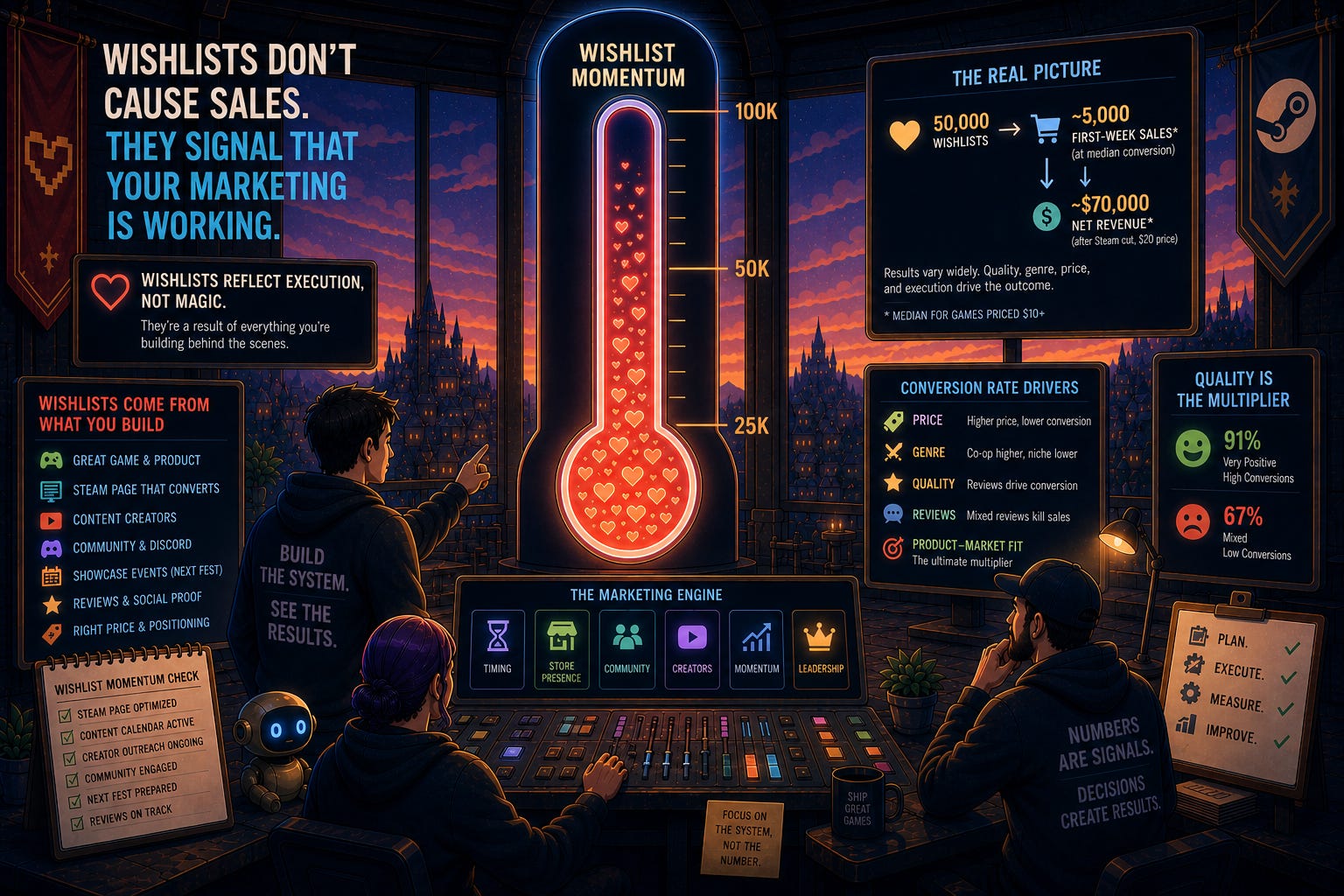
Steam wishlists are all the rage in game marketing, and have been ever since Steam first became a thing. This seemingly unassuming number carries a lot of weight and power: pump it high enough, and it can unlock publisher deals, loosen up the Steam algorithm, and accelerate word-of-mouth… or, it will lock you out of all of the above if you let it slip low enough. Long the definitive game marketing metric to track, wishlists have always served as a reliable (if flawed) indicator for both pre-launch interest and eventual post-launch sales.
But, since we’re in the year 2026, this picture isn’t quite so simple anymore. In such a chaotic and increasingly crowded market, served by an industry in flux and sustained by an audience pulled in every conceivable direction, wishlists aren’t as reliable an indicator as they once were; high wishlists no longer necessarily guarantee strong sales, for reasons as varied as each of the over 20,000 games that launch on Steam each year.
And yet, wishlists remain a supremely important metric to track, especially for indie studios. In the absence of a crystal ball or time machine, wishlists are the closest thing to a launch performance forecasting tool that indies have at their disposal. But just like with a weather forecast, it’s more important than ever to know how to read your wishlists correctly, and to come in with a crystal-clear idea of their strengths and limitations as an indicator, as well as what they can and cannot predict on a fundamental level.
That is what we’ll be going over today: how to actually use your wishlists as a useful barometer for both anchoring your marketing strategy and evaluating the health of your six-pronged marketing engine.
So, with all that in mind, let’s start with a nice, round number:
50,000 Wishlists
Tell me… What does that number even mean? And relative to what? How many sales can you expect at launch from that number? Is that even a good number? After all, 50,000 wishlists sure sounds like a lot, and it feels validating; it feels like 50,000 people who want your game! After all, isn’t that what the very term “wishlist” implies?
But at the median conversion rate for indie games, a $10 indie game with 50,000 wishlists only converts to roughly 7,500 first-week sales, or roughly $105,000 in Week 1 revenue (net, after Steam’s 30% cut). Which isn’t nothing, but it’s probably not what you envisioned when you saw “50,000.”
And keep in mind that’s the median. This is an enormous range; some games with 50,000 wishlists sell only 750 copies in week one, while others sell over 75,000. The conversion rate varies by an order of magnitude depending on the game’s genre, price, quality, and how well the studio/publisher executed its marketing.
Wishlists are the most watched number in indie game marketing, and also the most misunderstood (often fatally so). But since you’re reading this article, that won’t be the case for you! So let’s start by clearing some things up about this maddening, mystical, and mysterious marketing number.
How Many Wishlists Convert to Sales?
First, let’s start with a quick terminology refresher: in marketing, a “conversion” is the act of turning a prospect or visitor into a paying customer. In other words, it’s a sale; if a wishlist “converts,” it means the player who wishlisted the game actually ended up buying it.
So, how many players who wishlisted a game will ultimately purchase it? Unfortunately, we can’t see into the future, so it’s impossible to say for certain. But we can work backwards from the past, which is exactly what the discoverability oracles at The GameDiscoverCo newsletter did!
Their analysis of all Steam titles with over 25,000 wishlists, released between September 2024 and September 2025, found a median first-week conversion rate of 0.15x. And knowing that number lets us do a little math! That conversion rate of 0.15x means that for every 100,000 wishlists at launch, the median game will sell about 15,000 copies in Week 1.
That said, we do need to place a few asterisks on that magical predictive conversion rate, for the following three reasons:
Price matters. Games above $10 at launch actually converted at a median of 0.10x, a full third lower than the overall figure! This means that for most indie and AA titles, which generally price between $15 and $30, the 0.10x number is actually more realistic than the 0.15x headline. So going back to our example: that same 50,000 wishlist game, but priced at $20 and using the price-adjusted median, can expect around 5,000 first-week sales and roughly $70,000 in net revenue.
Genre matters, too. Yes, the type of game you’re making will affect your conversion rates, too. Different personalities gravitate towards different types of games, which means that different genres will attract different audiences that constitute different market sizes and display different purchasing behaviors. For example, co-op games convert at significantly higher rates, mainly because social dynamics drive group purchases (which is obviously highly relevant for… *ahem* group games). Meanwhile, narrative-focused and niche indie titles often convert lower because their audiences approach their purchases more deliberately; in other words, they’re more likely to wishlist and wait for a sale. Funnily enough, NSFW games convert unusually high, because they have dedicated and comparatively price-inelastic audiences; they buy at full price rather than wishlisting and waiting on a sale, for what I’m hoping are fairly obvious reasons that I don’t need to spell out in a family-friendly newsletter.1
Game quality matters most of all. This last point, I cannot overemphasize. Underperforming titles in GameDiscoverCo’s dataset launched to a median first-week user score of 67% (Mixed). But the overperformers, on the other hand, launched to 91% (Very Positive). I hope that correlation illustrates why this might be the most important caveat of them all. The fact of the matter is, no amount of wishlist volume can overcome a Mixed review score. More than just a marketing metric, a game’s conversion rate is also a product-market fit signal, and no amount of the former can overcome a deficit in the latter.
Wishlists Are Ultimately a Lagging Indicator
I get a fair amount of pushback from weighting Wishlist Momentum at only 15%, and I think that’s because it feels far too low for a metric that practically every studio obsesses over.
But I have a very good structural reason for doing that: wishlists, in and of themselves, don’t cause sales. Instead, they reflect the underlying marketing execution that actually causes sales. A high wishlist count is evidence that all the things you’re doing to market your game are working: you’ve made use of your runway, your community is growing, your Steam page converts well, and you have a fully-oiled and functioning discovery layer. A low wishlist count, meanwhile, signals that something upstream in your marketing engine is broken.
If I’d weighted wishlists too heavily, that would allow a studio enjoying a single viral moment to mask deeper structural weaknesses in their marketing system. A TikTok clip with millions of views could push wishlists to 30,000 in a week, producing a strong Wishlist Momentum score… even though the studio has no community, isn’t building relationships with creators, hasn’t written a GTM plan, and has no one leading their marketing. That studio’s Scorecard would say it’s “On Track,” when it really isn’t; so the 15% weight ensures that it doesn’t.
FirstLook’s 2026 survey of 250+ senior studio leaders (which I’ve already cited many times in this newsletter) reinforces my reasoning, by the way: 93% of studio heads said they cannot reliably predict whether a game will be a commercial success based on pre-launch metrics including wishlists. 76% had fully believed they had a hit on their hands, based on pre-launch data… only to watch the game underperform. Meanwhile, 83% had worried that their game looked weak, only for it to exceed their expectations.
Wishlists might be the most visible number (which is precisely what makes them valuable), but they’re far from the most predictive. Not even close, actually. As I covered in Part 5, Discord community growth was the number one unseen success factor for sleeper hits, cited by 48% of studios (nearly half!). It outranked wishlists, YouTube views, and press coverage… which means that the metric that studios obsess over the most turns out to tell you far less than something most studios barely track.
What the Scorecard Measures
Speaking of the Game Launch Readiness Scorecard, let’s have a look at what it asks here. The Wishlist Momentum category works differently from the other five — instead of fixed-answer multiple choice questions, it takes your actual wishlist count and scores it against industry benchmarks, with 30,000 wishlists as the primary planning threshold (ie, the wishlist count that reliably clears Steam’s post-launch revenue floors, even with conservative conversion).
NOTE: I had to revamp the way the Scorecard evaluates wishlist count, in light of Steam’s recent changes (detailed in the section below). So if you’ve already taken the Scorecard, you may want to take it again to see how your Wishlist Momentum score changed!
This category also feeds the Wishlist Revenue Projector, which I’ll break down in detail in the next piece. The projector takes your wishlist count, applies the appropriate conversion band, accounts for the Steam cut, and produces a revenue estimate. Just keep in mind that this is a planning tool, not an ironclad prediction (it may seem subtle, but the difference between the two does matter!).
The Visibility Landscape (As of June 2026)
The discovery landscape on Steam shifted significantly while I was writing this; in fact, I had to re-do this entire section, and even completely rework how the Scorecard scores wishlists! A lot has changed in just the past few weeks, and you need to understand the new terrain.
Fortunately, that’s what I’m here for! It’s quite literally my job to keep you fully apprised of these changes in the game marketing landscape. So with that in mind, here’s what you need to know about Steam’s big recent changes:
What Changed: Popular Upcoming, the storefront section where indie games with roughly 7,000 wishlists could appear on the front page before launch, now has an effective entry floor of about 80,000 wishlists. This section, which selects and displays games algorithmically rather than chronologically, already heavily favored AAA and viral indie titles; now, after this update, Popular Upcoming is no longer a reachable milestone for most indie games and even a good chunk of AA titles.
So if you’ve seen older advice telling you to aim for 7,000 wishlists to trigger the Popular Upcoming algorithm, beware: that advice is now obsolete. With one fell swoop of Steam’s fingers (or rather, more likely, a click of a mouse), the most actionable milestone every indie studio was chasing has just disappeared.
What Replaced It: From the ashes of every indie team’s Popular Upcoming dreams, Valve launched Personal Calendar, a discovery system that matches upcoming games to players based on playtime profiles and tag affinity. Most importantly, it has no wishlist floor, and it retrains daily. Early developer reports confirm it’s heavily weighted toward smaller games, with one mid-sized indie reporting gains of over 1,000 wishlists in a single day from the calendar alone.
This shift has profound implications for how you, as an indie developer, should think about your pre-launch visibility. The old model, roughly, looked like this:
Accumulate at least 7,000+ wishlists (and ideally much more than that)
Appear on Popular Upcoming
Gain 1,000-3,000 organic wishlists per day
Clear Steam’s revenue threshold for algorithmic visibility, ride the wave
That ladder had a clear first rung with a numeric target that was quite achievable for even a small indie team executing a disciplined marketing strategy. The new model, meanwhile, looks like this:
Optimize your tags and genre identity
Personal Calendar matches you to the right players
Those players wishlist based on tag affinity and store page conversion
If your tags are well-matched, you can still clear the threshold and ride the wave
So the first rung is no longer a concrete number to shoot for; now, you must ensure the quality of your game-to-player match. Which actually reinforces this series’ main argument.
What Hasn’t Changed: Basically everything else! Post-launch visibility on Steam is still primarily driven by revenue, and Valve’s New & Trending algorithm still uses Week One revenue as your game’s primary signal. Steam’s ~$10,000 Week One revenue floor for algorithmic promotion still very much applies... which means that the 30,000-wishlist “publisher cushion” (the wishlist count that reliably clears that revenue threshold, even with conservative conversion) is still useful as a planning benchmark, even though the mechanism for reaching 30,000 has decisively shifted.
Another thing that remains unchanged: above 100,000 wishlists, prediction models become significantly more reliable and Steam’s organic promotion becomes a major driver of both wishlists and sales. VG Insights found that wishlist-to-sales correlation strengthens substantially above 100,000 wishlists… whereas for smaller projects, the relationship between wishlists and sales becomes much less predictable.
The Bottom Line: This is a tactical shift; the strategic picture remains mostly unchanged. You still have to start early, you still have to build community and creator relationships, you still have to optimize your Steam page, and you still need a marketing leader to own the outcomes. But yes, you do need to prioritize your activities (specifically, your Steam page optimization) a little differently now.
For Indies specifically, your three highest-leverage pre-launch activities are now:
Optimizing your tags: use specific tags, use tags that accurately describe your game, use all 20 tag slots
Building your community: aka, the channel you directly control, independent of the whims of any storefront algorithm
Cultivating creator relationships: build the discovery layer that operates entirely outside Steam’s ecosystem
Getting listed on Popular Upcoming used to be an attainable and realistic fourth lever, but following these changes, it no longer is. But not all is lost, because Personal Calendar may well replace it… as long as your tags are good enough for the system to find you.
The Three Wishlist Traps
Surprise! Could you have guessed? There are three wishlist traps I’ve observed indie studios making time and time again. So just like with the other categories, I’ll spell them out here so you can learn from their mistakes:
Chasing the number instead of the system. (AKA “Goodhart’s Law claims another casualty.”) Studios often fixate on raw wishlist count and, as a consequence, tend to optimize for the wrong things. They run giveaways that inflate wishlists with low-intent users, and even buy traffic that hits the “add to wishlist” button but never actually converts at launch (or anytime after). They’ll pop champagne for hitting 10,000 wishlists without ever asking whether those 10,000 people are actually their target audience and will ever buy their game. But don’t be fooled — a single wishlist from someone who’ll buy your game at full price on Day One is worth 10 wishlists from people who added it during a giveaway and will wait six months for a 75% discount.
Comparing your number to the wrong benchmark(s). People often ask me, “We have 15,000 wishlists! …Is that good?” Well, it depends… on when you launch, what you charge, what genre you’re in, and what your review score ends up looking like. 15,000 wishlists for a $7 roguelite launching next February is in a very different position than 15,000 wishlists for a $25 narrative RPG launching this December. The median conversion rate is not meant to be a verdict; treat it as a starting point for both your own research and your marketing efforts.
Treating wishlists as a finish line. Wishlists accumulate. Sales happen once (per customer). A strong wishlist count at launch is the beginning of your revenue story, not the end. The Steam notification that fires when a wishlisted game launches is PC gaming’s highest-converting marketing channel, but it only fires once. After that, your revenue depends on reviews, word of mouth, sales events, and the long tail. Don’t spend all your energy on pre-launch wishlist growth and none on post-launch retention, unless you want to build a spike instead of a curve.
What a Healthy Wishlist Curve Looks Like
If wishlists are an imperfect indicator, what should you actually track? Well, funny you should ask, because I can confidently recommend two metrics to keep a closer eye on than raw wishlist count:
Wishlist Velocity. Your daily rate of new wishlists is a far more useful metric than your absolute wishlist number. A game adding 50 wishlists per day at launch minus 6 months, and 200 per day at launch minus 2 months, is accelerating at a healthy clip. But a game adding 200 per day at launch minus 6 months, and 50 per day at launch minus 2 months, is decelerating. If your wishlist velocity is declining, take heed; deceleration before launch is always a warning signal, regardless of how many total wishlists you have.
Wishlist Conversions. Your conversion rate itself (assuming you have access to it through prior launches, or Early Access data) will tell you far more about your launch performance than your wishlist count will. A game with 20,000 wishlists and a 0.25x conversion rate will outsell a game with 40,000 wishlists and a 0.08x rate (the math doesn’t lie!). And your conversion rate is largely determined by all the factors we’ve covered over the past seven weeks: how early you started marketing, whether you kept it up, how much your community trusts you, how good your game is, and whether you reached the right audience in the first place.
This is the most useful frame for wishlists I can think of: Wishlists are a thermometer, not a thermostat. They tell you the temperature of your marketing efforts, but they don’t set it. If the number is low, don’t try to fix the thermometer; fix the thing it’s measuring, instead.
And this is even more the case following Steam’s recent changes. Under the old system, you could aim for a specific wishlist count as a marketing milestone in and of itself. But under the new system, the milestone is now completely upstream of wishlists; now, it’s all about whether you’ve tagged, positioned, and presented your game in a way that the algorithm can find the right players for you. But wishlists can still function as a useful barometer for how well you’re doing that, as long as you remember to not Goodhart’s Law your wishlist count.
“But a Publisher Just Said Wishlists Don’t Matter!”
At GDC 2026, Playstack’s head of discovery, Patrick Johnson, added his voice to a chorus that’s become increasingly vocal over the past year: wishlists aren’t as reliable a signal anymore. He’s far from the first to say this (indeed, in these very pages I’ve echoed others who’ve said as much), but it certainly feels significant that the studio that signed Balatro no longer believes wishlists matter as much as they used to. When they found LocalThunk, the game had barely any followers and barely any wishlists, but they reached out anyway. Their quick discovery beat the raw metric… indeed, it’s what made all the difference.
Take that seriously, but don’t read too deep into it or extrapolate too much. Despite the fact that Balatro exists, wishlists are not a vanity metric. They’re still very important to track.
Also, notice who’s speaking here.
Playstack is a publisher scouting for partners. Their job is to spot an undervalued game before the market does, so a low wishlist count isn’t a red flag to them; indeed, it’s basically the opposite, because it signals an opening. Being a publisher, they have a marketing org, a distribution machine, and a checkbook that can all either surface or manufacture demand that a game’s wishlist count hasn’t yet captured. For Playstack, wishlists are indeed a lagging signal that they can afford to ignore.
But you are not Playstack.
If you’re self-publishing your game, nobody is going to ride in with a marketing budget to paper over your quiet launch. You aren’t using your wishlist count as a scouting metric… indeed, for you, it’s the foundational mechanism that undergirds your entire marketing engine. On launch day, Steam fires a notification to every wishlister, and that Day One purchase velocity is what tells the algorithm whether or not to show your game to people who didn’t already know it exists. If you don’t have wishlists, your potential players simply don’t get that notification, which means you don’t get a launch-day spike or the subsequent algorithmic visibility cascade. A publisher can (usually) buy past that gap. You, however, can’t.
So when a publisher tells you that wishlists are overrated, or a vanity metric, hear the whole sentence: for a publisher’s scouting process, yes they’re overrated. But for your launch, they’re essential. The number itself was never the point… what the number predicts, however, is everything for you.
Recalibrate Your Expectations
You probably don’t need me to tell you how brutal the economics of this industry are. But this is important enough that it’s worth reinforcing, so let’s put the math in concrete terms for a typical indie launch scenario.
A game priced at $20 with 30,000 wishlists at launch, using the price-adjusted median conversion rate of 0.10x, can expect roughly 3,000 first-week sales. After Steam’s 30% cut, that’s about $42,000 in Week One revenue. Year One revenue, including the long tail and sale events, typically runs 3-5x the first-week number… so perhaps $125,000-$210,000 in the first year.
Is that enough? That fully depends on how expensive making the game was. For a solo developer with low burn, that might well be a life-changing windfall. But for a 15-person studio that spent two years in production, it’s highly unlikely to cover costs. So the lesson here is that your wishlist count doesn’t tell you if your game will be profitable; it only tells you, roughly, what your first check might look like.
That’s why the next piece in this series breaks down the Wishlist Revenue Projector in detail. That’s the tool I’ve built into the Scorecard that runs these numbers for your specific situation, with your specific price point and your specific wishlist count. It’s not a crystal ball, and it can’t predict the future, but it can make these assumptions visible so you can plan against them instead of hoping or coping.
Take the Game Launch Readiness Scorecard →
Next Week: We’ll dive into the math behind the Wishlist Revenue Projector! I’ll break down how it works, what it assumes, and what it can and can’t tell you.
Insert coin to continue,
~Jay
Spawn Point Marketing offers fractional marketing leadership services for indie and AA game studios. For more information, visit https://spawnpointmarketing.com
Well, price inelasticity only partly explains this dynamic. There’s also the fact that NSFW content has fewer discovery channels available to it (these games are not featured on storefronts, and creator coverage is often more limited than for SFW genres), so the audience that does find and wishlist these games tends to be highly self-selecting and high-intent. In any case, this behavior produces higher Day One conversion ratios relative to wishlist count.