
Marketing Metrics that Actually Predict Game Success
(Hint: It's NOT wishlists!)

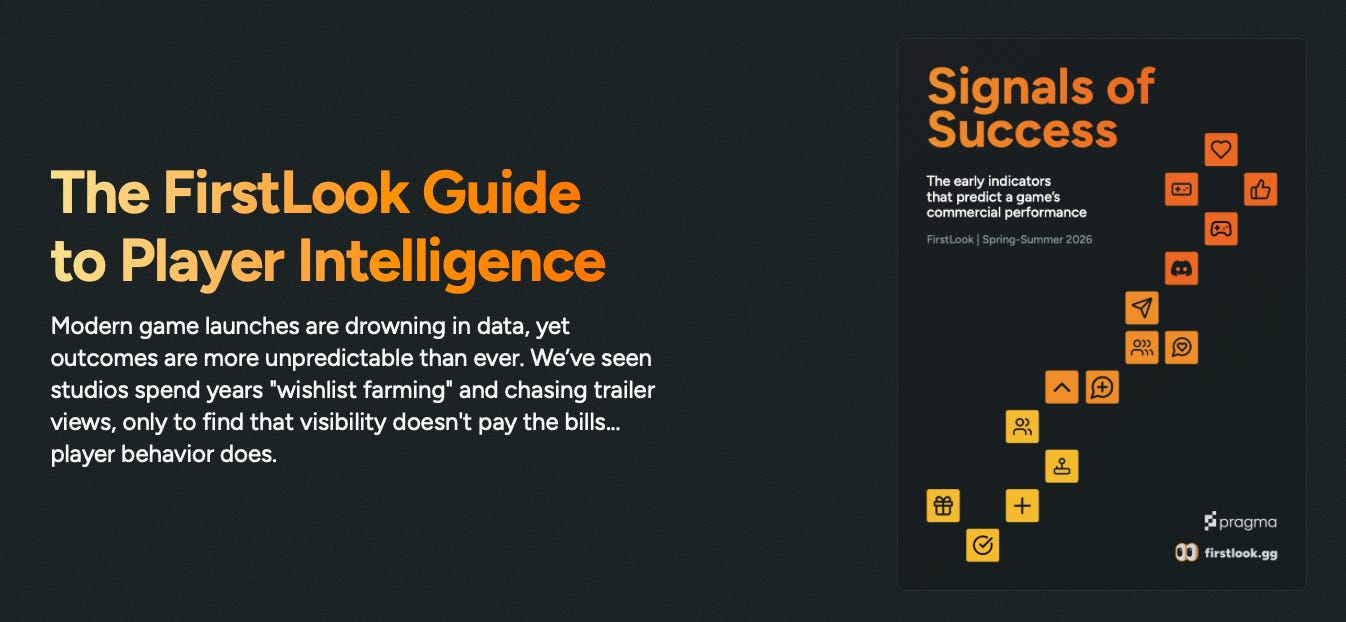
I’ve been reading through an interesting new report. If you’re a studio head, take heed of the uncomfortable truths therein.
FirstLook surveyed 253 senior AA and AAA studio leaders (C-suite executives, VPs, marketing directors) across the US, UK, and EU, and found that 93% of them say they cannot reliably predict whether a game will be a commercial success or failure before launch.
…Whoa. I’m honestly kind of speechless. Think about what this means for a second. Almost nobody knows whether their game will succeed or not, despite tracking wishlists, monitoring trailer views, analyzing social media engagement, and generally having more marketing data at their disposal than at any other point in gaming history. The industry is practically drowning in metrics, yet is still flying blind.
But wait, there’s more!
The report also found that 76% of studios have, based on pre-launch signals, believed they had a hit on their hands… only to watch the game underperform. And on the flip side, 83% have worried a game looked weak before launch… only for it to exceed expectations.
So, basically, 3/4s of studios have been fooled by false positives, while false negatives have fooled more than four out of five. The metrics most studios are tracking are so imprecise as to be actively misleading.
I’ve been saying for a while that vanity metrics are killing game marketing strategy (indeed, digital marketers in other industries have long figured out to ignore them), but I didn’t have numbers this stark to back it up. Now we do.
So… what actually works? Fortunately, FirstLook’s data also tells us. Let’s have a closer look!
When studios were asked which early indicators were most commercially meaningful once players actually got hands-on with a game, their top responses weren’t wishlists or trailer views, but rather hours played (cited by 41% of respondents), replay rate (30%), and Day 1/Day 7 retention (29%). In other words, behavioral commitment — not passive awareness — predicts revenue.
And here’s yet another bombshell finding: for surprise sleeper hits that exceeded expectations, studio heads identified Discord community growth as the number one unseen success factor. A full 48% (ie, nearly half) of studios cited it, outranking YouTube views, social engagement, press coverage, and yes, wishlists.
Oh, and it gets better (worse?). Discord growth is the single best predictor of a sleeper hit, and most studios don’t even measure it properly! Only 40% of studios currently track their Discord community in a structured way. So here we have industry’s most reliable early warning system for commercial success, and most of the studios that need it most are completely ignoring it!
The power of Discord growth as an indicator actually makes intuitive sense when you think about what it really represents. If you’ve ever joined a Discord server, you know it isn’t a passive action. It’s not like hitting “Add to Wishlist” on Steam while browsing during a sale, nor is it like clicking “follow” on an Instagram profile. Joining a Discord server means someone took the effort to seek out your community, committed to being there, and is actively engaging with other people who care about your game. Think about the difference between someone glancing at your restaurant’s menu on Yelp, and someone making a reservation and telling their friends to come, and you’ll get a sense of the difference in effort and commitment involved.
Eden Chen, FirstLook’s CEO, put it well when he said that the teams that win are measuring commitment over chasing vanity metrics. And this has enormous implications for how studios should be thinking about marketing from day one.
If wishlist count alone doesn’t predict success, then optimizing purely for wishlist volume is misallocating your marketing effort. Clearly. Now, it’s not that wishlists don’t matter — they clearly do, as one signal among many. But they’re a top-of-funnel awareness metric, and awareness without intent is just noise.
If hours played, replay rate, and retention are the real commercial indicators you should be paying attention to, then your marketing strategy needs to work backwards from the quality of your engagement. That means treating your demo as a measurement tool in addition to a conversion tool. Once your demo drops, ask yourself:
How long are people playing it?
Are they coming back?
Are they telling their friends?
Those signals, whether during a Steam Next Fest or a public beta, are worth far more than any wishlist count.
And if Discord community growth is the number one indicator for sleeper hits, then community building isn’t a “nice-to-have”; it’s quite possibly the most important thing your marketing team should be doing during development. And proactive, effective community building involves far more than just posting announcements and running contests. You have to build a place where your future players want to spend their time and talk to each other about your game. That’s active demand, and what becomes the signal in the noise.
I keep coming back to a theme you’re going to hear me harp on repeatedly in these pages (so apologies in advance for that, but it’s really important and it absolutely bears repeating until you’ve fully internalized it to the point of reflex): you’ll only have the data you need, and have it when it matters, if you treat marketing as a pre-production discipline instead of just a launch-week expense.
After all, you can’t measure Discord community growth if you don’t even have a community yet! And you similarly can’t evaluate demo retention if you haven’t built a demo and put it in front of players. Also, if your Steam page went up three moths before launch, you’re not going to be able to meaningfully track engagement signals. That’s not enough time. You need at least six months, and preferably closer to 18 months, at minimum.
Because it’s not like the 93% of studios that can’t predict success are lacking data; they have more data than they know what do with. They’re simply measuring the wrong things, at the wrong time, using the wrong framework.
Your marketing leadership needs to know which signals matter, when to measure them, and how to act on them. This isn’t a luxury for studios with big budgets, by the way — the fractional model is increasingly putting that caliber of marketing leadership within reach of teams of all sizes. Take advantage of this, because it’ll determine whether your studio is one of the 76% that got blindsided by a false positive, or one of the lucky savvy few that knew exactly what they had before shipping.
What metrics does your studio trust most before launch? And has one of your games ever surprised you (in either direction), despite what the data said?
To your success,
~Jay
Spawn Point Marketing offers fractional marketing leadership services for indie and AA game studios. For more information, visit https://spawnpointmarketing.com