
Why Content Creators Are Essential for Indie Discovery
Ready Check #7: The Launch Readiness Series
This is the seventh article in Ready Check, a weekly series of 12 articles on launch readiness for indie and AA games that serves as a companion compendium for my Game Launch Readiness Scorecard. While each individual piece focuses on themes and provides tips that stand on their own, they also build on and reinforce each other, so I recommend reading them in order. To catch up, start here:

New installments of Ready Check will drop each Monday at 7:00 a.m. Pacific Time. If you haven’t already, be sure to subscribe to Spawn Point Marketing so you don’t miss any:
Oh, and I’m hosting a free webinar with the fine folks at Game Dev Assembly Editors soon! It’s called “Building a Marketing Engine for Your Game (Without a CMO)”, and we’ll go deeper into how to build a scalable, repeatable marketing engine for your game… even if you have to DIY it!
WHEN: Tuesday, June 9, 2026 @ 9am Pacific Time [TOMORROW!]
LENGTH: 60 minutes total (40 min presentation + 20 min Q&A!)
COST: FREEEEE
Snag your spot here:
They say that the fundamentals of marketing never change. And to a certain extent, this is true; marketing is simply the art and science of understanding the person you want to sell your product or service to, and convincing them to buy it. As such, as long as human psychology doesn’t change, neither will the basics of marketing.
But in an era like the one we live in, defined and shaped by massive technological change and all its downstream shifts in behavior and media consumption, this doesn’t entirely hold true. And game marketing provides an instructive case study. Back in the day when I was growing up in the 80s and 90s, marketing a game looked a lot like marketing any other product: a mix of print and broadcast ads (including some gloriously cursed ones, brought to you by Nintendo of all companies), press coverage in actual physical magazines that you could hold in your hand, sales promotions (both consumer-focused promotions, and “trade” promotions aimed at wholesalers and retailers), product placement in other media like movies, in-person events, and yes, even direct mail (fellow Millennials, raise your hand if you remember the Star Fox 64 promo VHS that Nintendo Power sent to their subscribers… yes, they actually sent practically every kid in America an actual VHS tape containing a 10-minute ad for Star Fox 64, and you better believe we ate it all up).
What a difference just a few decades make.
Fundamentally, all these channels are still in use. But they look and operate very different in 2026 than they did in 1996. Digital marketing of all stripes is now king; sales promotions now take the form of discount codes and Steam sales, email blasts have taken physical mailers’ place, ads (now digital as well as print and broadcast) are still effective for the AAA publishers who can afford them but are otherwise too expensive and low-ROI for indies, and the press is increasingly irrelevant in the eyes of players, their function now being almost entirely performed by online content creators: YouTubers, Twitch streamers, TikTokers, podcasters, and yes, even bloggers and Substackers.
Oh, and you’d better believe there’s data to back this up! In fact, if you’re an indie developer, there’s one number I want to call your attention to, because it will (or should) completely reshape how you think about marketing your game:
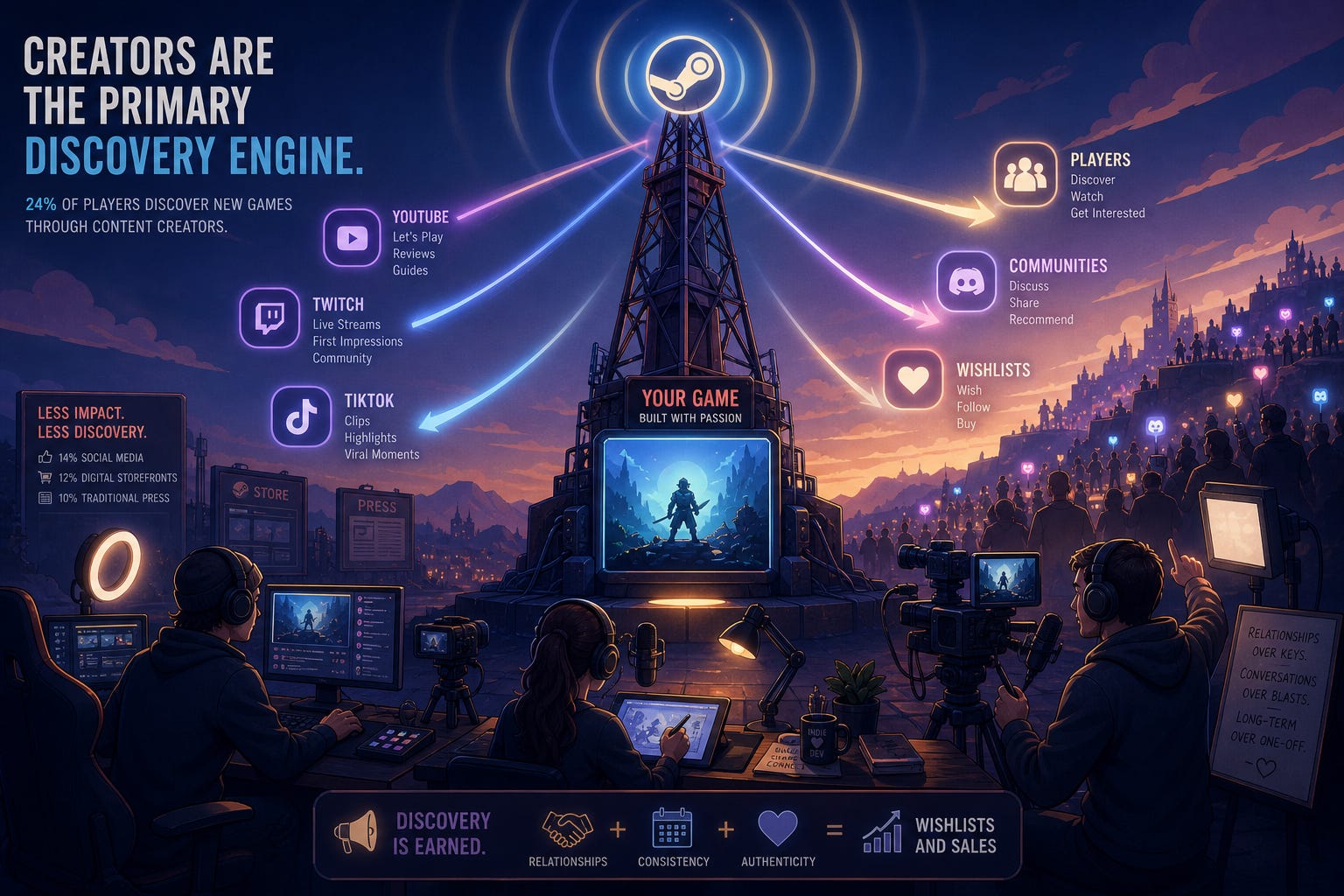
24% of players discover new games through content creators, the most out of any channel.
Meanwhile, just 14% discover them through social media, and only 12% through digital storefronts. The press, meanwhile, comes in at a paltry 10%… and for Gen Z, it’s as low as 6%; for Gen Alpha, it’s basically negligible.
That’s from Bain’s 2025 survey of over 5,000 gamers across six countries, which I’ve cited quite a bit in these pages. The takeaway for indie marketers? It’s actually quite simple: in 2026, video games’ primary discovery channel is no longer the storefront where you buy them, the social platform where you post about them, or the media outlet that reviews them, but the creator who plays them on camera.
For indie and AA studios, this is actually the best news, as it represents one of the new gaming market’s most underexploited opportunities. Content creators are the single most powerful discovery channel available to you as an indie developer… and yet, most studios either a) completely ignore them, or b) approach them so badly that they might as well have.
What This Category Measures
Content & PR Readiness is weighted at 15% on the Game Launch Readiness Scorecard, as much as both your Steam Page and Wishlist Momentum. Like the previous two categories, it asks you three questions:
Is your press kit ready?
Are you reaching out to content creators?
Are you participating in showcase events (like Steam Next Fest)?
Together, these three elements form the discovery layer, which is the infrastructure that connects your game to the people who’ll talk about it. There’s a nuance here that I want you to make note of — it doesn’t connect you to the audience directly, but to your game’s amplifiers: the creators, press, and events that turn your game from something that merely exists somewhere deep in the annals of Steam into something people will have actually heard about.
I weighted this one at 15%, because discovery infrastructure is executional in nature. Unlike Timing (which determines your runway) or Community (which compounds the trust that players place in you), what you get out of discovery fully reflects and depends on what you put into it. You reap what you sow, in other words. It doesn’t compound the way community does (these are linear, not exponential, returns), but it is the primary mechanism by which people who’ve never heard of your game encounter it for the very first time. And so it’s very much worth paying attention to.
Why Creators Beat Press, Social, and Storefronts
Let’s return to that stat I opened this article with. If you look at the GDC 2026 State of the Industry survey, you’ll see it further confirms the channel hierarchy laid out in Bain’s report, but from the studio side. According to the GDC survey, the user acquisition channels that studios most use are:
Social media at 65%
Streamers and content creators at 39%
Paid advertising at 31%
Events at 30%
Community platforms at 28%, and
Traditional press and bloggers at 25%
No, those aren’t typos, and no, I didn’t forget how to read or count; I realize that social media is higher than creators on that list. But remember what I said back in Part 3 about looking deeper into the data instead of immediately taking it at face value? Well, this is actually another textbook example of why.
First off, there’s a subtle but meaningful difference between what studios use to find players, and what players use to find games. They’re often similar, but it’s not an exact one-to-one. And even considering that, “social media” at 65% is highly misleading as a standalone channel because most of the social media activity that drives wishlists is actually creator content being shared on social platforms. A TikTok clip of a game going viral is actually an instance of creator-driven discovery that the studio is nonetheless measuring as “social media.” So when you see a stat like this, keep in mind that the two channels significantly overlap.
Anyway, that accounts for social… but what about press and storefronts?
On this front, the data is clearer and far more unequivocal: creators outrank traditional press by a significant margin. That’s not because the press doesn’t matter at all (it does matter… kind of). But it’s increasingly clear that the press matters far less than it used to, because both player trust and media economics have decisively shifted away from it; in 2026, a single well-matched mid-tier YouTuber can generate more wishlist lift than three press features! It’s enormously asymmetrical, and this will only keep widening as the gaming press contracts and creator audiences continue to grow.
As for why creators outperform press and storefront features? It mostly comes down to the former having inspectable incentives. Think about it… when a creator covers your game, their audience can see why: the creator played it, and they either liked it or they didn’t. Audiences can see how the creator reacts and easily reference their track record. Content creators put their reputation (and, by extension, their livelihood) on the line each time they recommend a game, which gives them skin in the game (pun intended) and ends up becoming its own kind of “certificate of authenticity” that greatly inoculates them against player skepticism.
Press outlets, on the other hand, have institutional incentives that are much harder for players to parse, and reviewers also have a habit of alternating between using their masthead as a rhetorical sword or shield when their verdicts aren’t aligned with those of their audience, all of which further erodes trust from players.
Storefront algorithms, meanwhile, are infamously opaque and inscrutable; who really knows why Steam, Apple, or Google surface or bury one game over another?1 And as stores become ever more crowded due to more and more games launching each year, and as all those games compete with each other (along with existing games) for the same slice of finite attention pie, the chance of any particular given game being surfaced decreases accordingly. Obviously. And on top of that, it’s very much an open secret that having the right relationships with the right people at platform holders and storefronts can open algorithmic doors that remain shut for everyone else.2
But unlike press and storefronts, creator relationships are transparent, so players are more inclined to take them at their word. In a gaming scene and digital economy that puts a premium on authenticity, creators’ transparency may well be their strongest currency.
Key Blasts? No, Sir, I Don’t Like It
Studios make a lot of mistakes when reaching out to creators, but by far the most common blunder I see is the key blast: sending unsolicited Steam keys to a list of 500 creators using a templated email, and then waiting to see who bites.
Key blasts fail for three main reasons:
Every creator with more than a few thousand followers receives dozens of key blast emails per week (as a creator myself, I can personally attest to this), so yours simply disappears into the pile.
Also, a template email signals that you either don’t know or care about the creator’s content… and yes, they can always tell (again, I can confirm personally). If you don’t care about them, why should they care about you?
Finally, even if someone does claim the key, there’s no relationship. They might play your game, or they might not… but either way, you have no way to influence the outcome because you haven’t built the foundation for a true conversation.
But there is another way… a better and more effective alternative. It’s called relationship-based outreach, and yes, it can work for you too! Just adhere to the following best practices:
Work from a smaller list
Personalize your messages
Become genuinely familiar with each creator’s content and community before you start pitching
Adopt a long-term perspective (ie, don’t expect immediate results)
Instead of trying to get 500 people to cover your game once, you want to aim for building relationships with 20-30 creators who’ll cover your game multiple times across its development cycle. Naturally, the earlier you start building these relationships, the better.
Start by identifying creators who cover games in your genre. Forget about the biggest ones (the largest creators are always a moonshot, and will almost certainly want something3 in return for coverage), and instead focus on the ones whose audiences most match yours. A 15k-subscriber YouTuber who exclusively covers survival games is worth far more to your survival game than a 500k-subscriber variety streamer who’ll only play it once and then move on.
Tools like Keymailer, Lurkit, and Terminals.io help with discovery, but a human (and if you’re indie, let’s face it, it’ll probably be you) still has to manually conduct the outreach itself. For at least a few months before you even mention your game, watch and become familiar with their content, and comment as a fan, not as a developer. Then, when you do reach out with a pitch, reference specific videos they’ve made, and explain why your game fits their audience (not how helpful it’d be for them to cover your game… yes, obviously that would help you out, but frankly, they’re not going to care about that nearly as much as how you can help them out). And offer them a demo, not just a key. Your goal is to start a conversation, not to conduct a transaction… so don’t be transactional. Nothing will kill your outreach faster than being transparently transactional.
Oh, and do not wait until launch, or until the game’s “ready,” to start reaching out to creators. Not only will your pitches reek of desperation (and when has desperation ever done anything except push away the very people you’re trying to persuade?), you’ll be forgoing a ton of marketing potential that could’ve happened earlier in your development cycle. Creator audiences can help validate your gameplay loop, jolt your straggling community to life, and catalyze viral moments — all of which are priceless for an indie game in early development. It is never too early to start reaching out to creators.
Do you have a demo? You’re ready to start outreach.
Do you have a teaser trailer? You’re ready to start outreach.
Do you have a prototype? If you’re feeling especially bold, you’re ready to start outreach.
Yes, a creator won’t be able to actually stream your game until they’re able to play it. But they can still cover your trailer! Or your Kickstarter. Or your own content (like a particularly entertaining and engaging devlog). And then, once they’ve covered your game once, it becomes easier to ask them to cover it again. In fact, once you’ve secured coverage for your demo, you should send that creator each new build all the way up to launch. Each new update means more content for them, and more wishlists for you. It’s truly a win-win situation.
And even before you’re ready for them to start any sort of coverage, there’s absolutely nothing stopping you from warming up the relationship by engaging with their content as someone who truly enjoys watching their videos. Then, when the time comes to pitch, they’ll be much more receptive because you have an existing relationship; you’re no longer just one of the dozens of random, faceless developers who try to pitch them each week.
Just like with building your community, putting up your Steam page, and marketing your game period, you should start creator outreach way earlier than it feels comfortable.
Steam Next Fest: THE Highest-Leverage Free Event for Your Game
Steam Next Fest runs three times per year, and it’s the single biggest FREE marketing opportunity available to you as an indie developer. Data from the February 2026 edition makes this unequivocal.
The median demo earned 806 wishlists during the week-long fest.
Now, keep in mind that’s the median, which means half of all participants earned less than that. But the same goes in the other direction, and once you get to the hits, their results are truly staggering. To boot:
The 95th percentile earned 13,461 wishlists, and the top performer earned over 57,000.
This is an enormous spread, and no it’s not random. So, what did the “winners” do differently than the rest? In a nutshell, they had strong momentum going into the fest! Bottom line, the strongest predictor of your game’s Next Fest performance is the wishlist count you bring to the table before the fest begins. In fact, pre-fest wishlists correlated with fest earnings at r=0.825, which is an unusually strong signal by marketing research standards.
If you want an English translation, what that means in practice is that Next Fest amplifies momentum; it doesn’t create it. So don’t think that Next Fest is going to save you if you’re going in with middling (or, God help you, negative) wishlist velocity; a game entering Next Fest with 5,000 wishlists will earn substantially more during the fest than a game entering with 200! This is because the almighty algorithm reads pre-fest wishlists and recent velocity as quality signals, which it uses to distribute the demo accordingly.
This is partly why I kept hammering on Timing and Community in earlier pieces: your Next Fest performance is a downstream effect of everything you did in the months before. So go ahead and put your page up early, start building your community, pitch to creators, and build an email list and social presence ASAP. Do everything in your power to generate organic wishlists as soon and as much as you can, because Next Fest multiplies the work you’re already doing and have already done.
Oh, and if you’re participating in Next Fest, don’t obsess over your demo too much. I know this sounds counterintuitive, and it goes against a lot of indie game marketing advice I see bandied around the interwebs. But I’m not just pulling it out of a hat! In fact, I bet you (or the folks giving you the aforementioned advice… or simply most studios, period) didn’t know this juicy data piece: 68-88% of Next Fest wishlists come from people who never played the demo. They saw the capsule on the sale page, clicked through, read the description, and hit the wishlist button. The demo unlocks your visibility (after all, you can’t participate in Next Fest without one), but your store page does the actual converting. So if your capsule, tags, screenshots, and descriptions are weak (see Part 6), you will perform weakly during Next Fest regardless of how good your demo is.
(Now do you see why optimizing your Steam page is so important?)
There’s also a major critical constraint that you should keep in mind: you can only participate in one Next Fest per game, and only pre-launch games are eligible (oh, and Steam counts an Early Access launch as a launch; if your game is already in Early Access, then sorry, but Next Fest is off the table). So choose your slot carefully! Most experienced developers pick the last one before launch, when they’re at peak momentum leading into the fest and their Day One wishlist conversion is likely to be tightest.
Correct, Nobody Reads Your Press Kit (But Yes, It Still Matters)
Press kits feel a little archaic in 2026, don’t they? Kind of like an anachronistic relic of a bygone era (c. 1996–2020), when players still trusted and read gaming outlets, games journalists still curried favor from players, and an IGN feature was, in and of itself, a milestone accomplishment that could make or break a launch. Besides, most journalists straight-up won’t download a huge ZIP file and browse your fact sheet; if they decide to review or cover you, they’ll simply Google your game, land on your Steam page, and write from there.
So why does the Scorecard still ask if you have a complete press kit?
Well, it’s because the press kit isn’t really for the press… it’s for creators, event organizers, and anyone else who needs to talk about your game; it allows them to reference it quickly and accurately. A complete press kit allows anyone who wants to feature your game to do so without asking you for details or assets. And this is important because every friction point you remove from that process increases the chance that someone, somewhere, will cover your game.
The press kit also confers an immensely valuable second-order benefit: it forces you to articulate your pitch in a compressed format, which transfers to countless other marketing contexts (such as writing your Steam page’s short description). At the end of the day, if you can’t describe your game in one paragraph, your messaging isn’t ready... and if you don’t have high-res screenshots that show your game’s actual gameplay, then neither is your visual identity. Your press kit, in and of itself, is a readiness diagnostic. It indicates how ready you are to effectively promote your game… in other words, it tells you whether you’re ready to market your game at all.
Ok, so now that I’ve convinced you of this document’s utility, it’s time for you to put one together! A complete press kit will include, at the very least, the following elements:
A fact sheet
High-resolution key art
Screenshots
Logo files
Trailer embed
A one-paragraph description
And sure, you can throw in that press release you stayed up until 3am writing for the announcement. It’s not technically part of the press kit… but why not?
Oh, and platforms like presskit.gg make it trivially easy to set up a press kit. So really, there’s no reason not to have one. If you don’t have a press kit, that doesn’t mean your game won’t get covered, because if the press (or a creator) finds your game compelling enough, they’ll find a way to cover it anyway. But if someone does decide to cover it, they’ll simply use whatever assets they find… and those assets might not represent your game the way you want it to be seen.4 So… hop to it.
As Usual, Three Failure Patterns
Like with most of the other categories, I tend to see three overarching failure patterns relating to content creators, press, and discovery (I’m not quite sure why… maybe the number 3 really is mystical. Anyway, we’re getting a little too meta with patterns here, so let’s move on). Here’s how they manifest:
“We’ll do outreach closer to launch.” This one’s by far the most common one I see. And it doesn’t work because creator outreach has a minimum lead time of 4-6 weeks for cold contacts, and 8-12 weeks for building new relationships. If you reach out three weeks before launch, that window has long closed. Not only do you not have a relationship that would incline creators to help you out, but you’re not even giving them enough time to work with you! Most creators wouldn’t be able to schedule coverage within that timeframe even if they wanted to.
“We sent 500 keys and got 3 videos.” Also known as, “Tell me you sent out a key blast, without telling me you sent out a key blast.” To be fair, a 0.6% conversion rate isn’t unusual for blast outreach… it’s actually the expected result! But no, it’s not because creators don’t care about your game, or wouldn’t care about your game… the problem is that your outreach didn’t give them a reason to care about your game. Give them a reason to care about your game by building a genuine relationship with them first, and then by personalizing your outreach.
“We’re waiting for a press feature to save us.” You might as well buy a lottery ticket and pin all your hopes for funding your next game on winning the jackpot. You’d probably have better odds! Yes, press coverage can generate significant wishlists (though this is far less of a given than it was a decade ago), but it’s also highly unreliable because you can’t control when or whether a publication covers you. You’re essentially rolling the dice if you build your entire discovery strategy around press coverage. No, seriously… just go shoot craps instead (I made the lottery comparison for a reason); yes, in both cases the upside is real, and it’s potentially significant, but the likelihood of you actually winning just isn’t high enough to stake your future on. Press should be just one channel among many in a diversified discovery strategy, never the entire strategy in and of itself.
How to Build Your Game’s Discovery Layer
If you’re an indie marketer, your game’s organic discovery layer becomes even more critical (given that ads and other forms of paid acquisition are either beyond your budget or ineffective for your audience). So with that in mind, here’s a highly practical sequence for building out your game’s discovery layer, timed against a typical launch window:
1. At Launch Minus 6 Months: Build Your Discovery Infrastructure
Set up your press kit: fact sheet, key art, screenshots, and a trailer if you have one.
Start identifying creators in your genre by building a list of 30-50 creators whose audiences match yours, across a range of sizes (from micro to mid-tier), and start engaging with their content and communities without even mentioning your game.
If you haven’t already, register for your Next Fest slot (if your Steam page is live, it literally takes just a couple of minutes).
2. At Launch Minus 3 Months: Begin Active Outreach
Send personalized messages to your top 20 creator targets, offering them demo access. Start building the relationships that will produce the coverage you need at launch.
If you have a Next Fest slot coming up, coordinate your creator outreach to land one week before the fest opens. This is not so early that you’re completely forgotten about by the time the fest gets underway, but not so late that you’re buried in the pile.
3. At Launch Minus 1 Month: Fire on All Cylinders
By now, your discovery infrastructure should be fully operational. You should have established relationships with creators, distributed your press kit, and your chosen Next Fest (if applicable) should be wrapped up and completed. At this point, outreach shifts from building relationships to activating them:
Confirm coverage dates
Send final review builds
Coordinate embargo lifts
If your launch is three weeks away and none of this exists, you’re not necessarily doomed… but yeah, you’re absolutely playing on Hard Mode because you’re operating without a discovery layer, and your launch will reflect that. The Scorecard will tell you the same thing. The bottom line is, the discovery layer is non-negotiable for indie games, and in 2026, content creators are the discovery layer.
So I’d highly recommend that you delay launch if you can, because I guarantee the work you do to build your discovery infrastructure in the next 90 days will yield far more dividends than any frenzied and panicked outreach you’d cobble together in the next 21.
Take the Game Launch Readiness Scorecard →
Next Week: Wishlist Momentum! We’ll dissect the latest wishlist conversion numbers to discover what they actually predict, and we’ll learn why 50,000 wishlists doesn’t mean what most founders think it means.
GG,
~Jay
Spawn Point Marketing offers fractional marketing leadership services for indie and AA game studios. For more information, visit https://spawnpointmarketing.com
Well, besides me, that is! Obviously, I jest… but truth be told, any competent marketer should be able to reverse-engineer any major storefront algorithm with a fairly high degree of confidence. But from the consumer’s vantage point, algorithms might as well be as undecipherable and incomprehensible as an endritch god. The idol-worshipping scene in last week’s header image is not without meaning.
This tends to annoy everyone involved (especially when it’s obvious), except for the platform holders… which suits them just fine, since they hold all the cards. Unlike with the press, which saw its audience dump them for content creators once trust collapsed, it’s not like developers can choose to forego platforms that algorithmically screw them over, at least not without giving up a huge chunk of their future revenue. Though many a publisher has tried to break free of Steam’s stranglehold with their own launchers (with the closest to success being Blizzard with Battle.net), they all eventually gave in and now reluctantly offer their games on Steam again. Only the largest of mega-AAA publishers can pull that off successfully, and even then it’s not guaranteed (just ask EA and Ubisoft).
Though admittedly, this is starting to change, possibly for real this time. Studios and publishers are now making more successful attempts to either supplement stores like Steam or bypass them entirely, as shown by games like Path of Exile 2 and Neverness to Everness (respectively). And thanks to recent legal verdicts ordering Apple and Google to loosen their hold on their ecosystems, you’re starting to see this similarly play out in mobile. These games, by distributing directly to players, are demonstrating what a successful Direct-to-Consumer (DTC) model could look like in gaming. But it’s still relatively early days for that, and indie studios in particular are rarely in a position to shoulder that kind of risk (though games like Hytale may well prove to be trailblazers in this regard).
However, If/when indie DTC becomes more widely viable, or even possibly the norm, it will be in large part because of content creators accelerating the current trends we’ve examined this week of games, allowing indie studios to rely less and less on storefronts as primary discovery channels. Mark my words.
Usually, it’s $$$.
Again, as a part-time creator, I for one greatly appreciate studios that gather assets into a comprehensive, well-organized, and easy to find media kit. If you read through the Game & Word archive, you can easily sus out which games I’ve covered that had accessible press kits, just by comparing the quality of the screenshots and images I used.