
All Killer, All Filler
Mixtape's Press Problem: When Polish Becomes a Liability

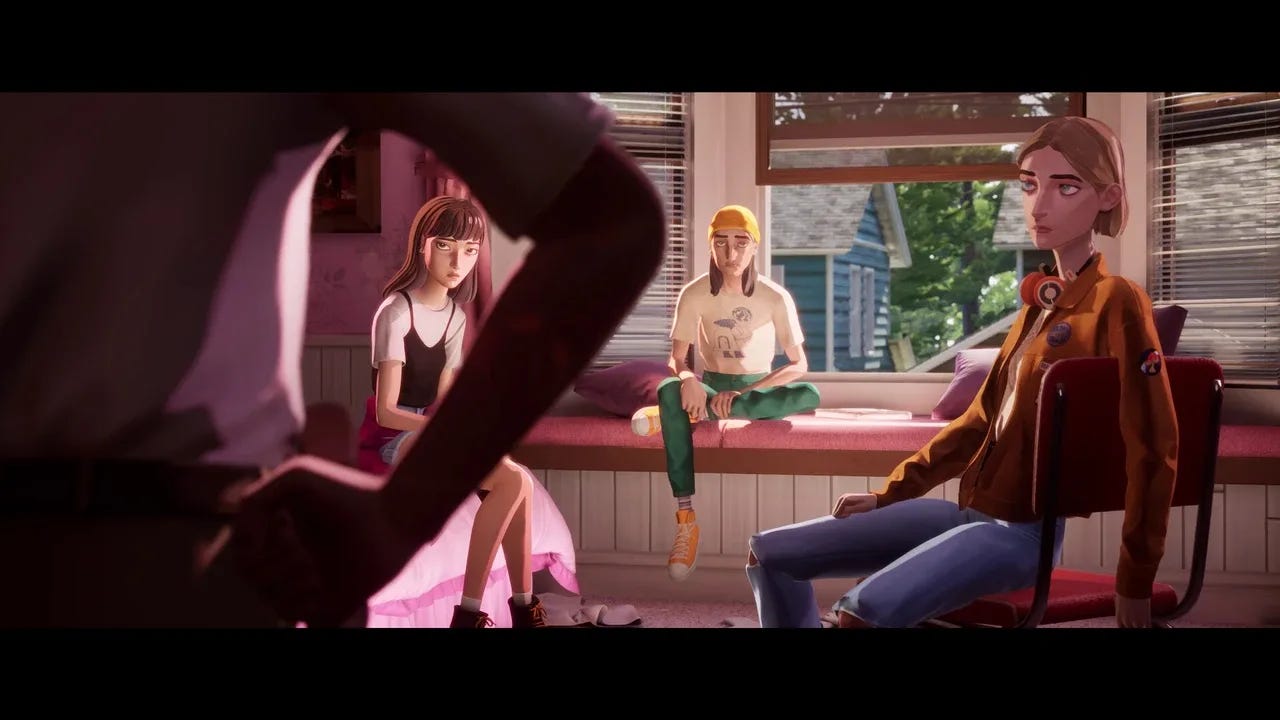
The discourse around Mixtape has been nothing short of exhausting, and I’m going to do my best not to add to it. YouTube has already beaten the culture war angle into the ground. Furthermore, the whole “is it even a game” debate is decades older than Mixtape (and won’t be resolved by Mixtape). And don’t even get me started on the conspiracy theories about who funded what and who got paid by whom. Give me a break.
But there’s a marketing story here that’s actually fairly interesting and somewhat instructive, which I feel is very much worth pulling apart. I don’t think Mixtape is a referendum on the medium, but I do believe what happened around it is going to keep happening, and if you’re an indie dev in particular you need to think very carefully about what to learn from it (and more importantly, what not to copy).
I’ve Got 10/10 Problems
Mixtape absolutely dazzled the critics, earning it a veritable tsunami of 10/10 scores from almost every prestige gaming outlet. It was the type of inescapable, unanimous critical praise that leads to the marketing team popping champagne in the break room.
But a critical sweep can backfire.
When I see a wave of perfect scores roll in for any game, my first instinct isn’t “Wow, this must be an incredible game!” Maybe 10 years ago, sure. But now, in the year 2026? I’m more apt to think “Huh… this is unusual.”
That’s because perfect scores from major outlets are vanishingly rare. For instance, consider IGN, the outlet that’s memed itself into a 7-out-of-10 stereotype (yes, we’re going to pick on them again today!). It was one of those outlets that gave Mixtape a 10/10.
Meanwhile (and let’s make this a clean comparison), they gave What Remains of Edith Finch an 8.8 back in 2017… and Edith Finch is a far more refined work by almost any narratival or gameplay measure. It had much better dialogue, for one, and its vignette structure was far more inventive. The game also feels like it actually earns its emotional payoff without industrial-grade nostalgia crack or a stellar soundtrack doing all the lifting.
Keep in mind this game is from the same publisher (Annapurna Interactive), is in the same broad genre, and has the same approximate runtime as Mixtape. They share a ton of ludic and thematic DNA. So it does make you wonder… why this one, but not that one?
Now, that’s not to say Mixtape is a bad game. It really isn’t! It won’t appeal to everyone (though that statement’s redundant on its face, as no game will ever appeal to everyone), but overall it’s a mostly enjoyable experience that doesn’t wear out its welcome.
Mixtape: The Good, the Bad, and the Theatre Kid
[A Spawn Point Marketing Mini-Review]
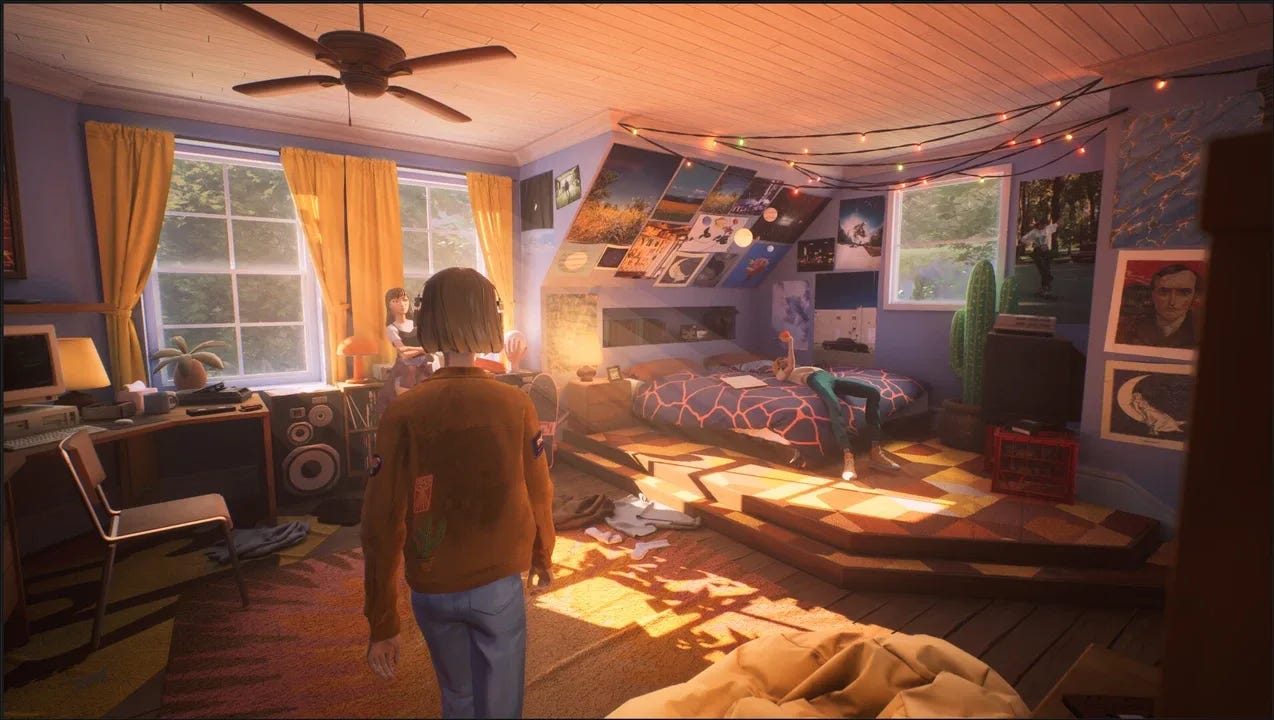
Yes, I played Mixtape. Yes, I finished the game (it only takes, like three hours). And yes, I have… ahem… MIXED feelings about it. Here’s a quick rundown of what I liked and didn’t (”loved” and “hated” are too strong; I just didn’t feel that strongly about it either way).
I really enjoyed the art style and found the choppy stop motion-esque animation charming. True to its genre, the presentation is pleasingly cinematic. And true to its name, Mixtape’s soundtrack is phenomenal, easily the highlight of the game. Thematically, it nails the mood of a late 20th-Century coming-of-age movie, and gets a lot of the 90s details right, down to manually rewinding a cassette tape. The Blockbuster video rental store sequence also had me chuckling the whole way through.
The story was… eh, it was ok? Decent and serviceable for a game. But on its own merits, the narrative was decidedly mediocre: it leaned too hard on played-out adolescent movie tropes, tried way too hard to be angsty and cool in that disaffected art-kid way, and was utterly drenched in a particular flavor of sheltered, Millennial-coded solipsism that I find increasingly insufferable as I age (oh geez… I suppose I’m a Boomer now). I do wonder if reviewers would’ve been this generous had Mixtape been a movie or prestige TV miniseries. That said, it had its moments, rarely got boring, was paced well, wrapped at the right time, and successfully evoked the feels more than once.
The characters were a similar mixed bag. They nailed the sheltered, angsty alt-kid archetypes the writers were clearly going for, and on a human level I could sympathize with their quaint interpersonal and familial struggles (which, I’ll grant, take on a far more existential quality in the throes of puberty). The trio’s friendship felt truly genuine, and it did a lot to sell them as protagonists.
But individually, they really grated on me, and if the game had lasted any longer I’m not sure I’d be describing them this generously. I can’t tell whether the cringe MFA-workshop dialogue or their overall pretentious and indulgent affect did more to sour me… much in the same vein as I absolutely cannot stand Holden Caulfield. These kids aren’t quite that insufferable and can even be likable at times, but they’re absolutely on the same spectrum.
The gameplay sequences, namely the baseball minigame and skateboarding bits (let’s just pretend that horrible kissing minigame didn’t happen), were enjoyable if not particularly challenging. Which, to be fair, is standard operating procedure for this genre. Walking sims center narrative above all. You don’t play these to get on the leaderboards; you buy into the genre for an experience closer to reading a book or watching a movie than “playing a game” as gamers traditionally understand it. If you saw Mixtape’s capsule art, read the Steam description, plunked down $20, and expected something else… then frankly, I don’t know what to tell you.
TL;DR: Overall, this was a competent linear visual-novel-esque walking sim telling a somewhat passable if lowkey cringe slice-of-life vignette about three sometimes-likeable, often-irritating angsty sheltered kids coming of age. It’s flawed: shallow gameplay, barely-likable characters, MFA dialogue galore, and that one awful kissing minigame I swore I wouldn’t mention and I’m so sorry for reminding you of it again. But it also gets a lot right: visually pleasing, well-paced, killer soundtrack, the nostalgia bait actually works, the story is genuinely evocative in places, and it’s an engaging experience for the most part (even if, as I suspect, it’s mostly the soundtrack, nostalgia, and visuals doing most of the lift here).
So, there you have it. I personally wouldn’t replay it, and I probably would’ve stuck to Crimson Desert if the discourse hadn’t compelled me to try it and form a real take on it… but if you’re into this genre and have a tolerance for ouroboric adolescent solipsism, it’s nice to unwind with for a few hours while jamming out to its surely-expensively-licensed OST. It’s enjoyable for what it is, and there are certainly worse games you could spend an afternoon with.
I wouldn’t have scored it a 10/10, though. Think about what that score means: as close to perfect as a game can be, a game that has earned a spot amongst the pantheon of greats. For comparison, here are some other games that IGN has bestowed with that honor:
The Legend of Zelda: Ocarina of Time, Skyward Sword, Breath of the Wild, and Tears of the Kingdom
Pokémon Red and Blue
Metal Gear Solid 4 and 5
Grand Theft Auto IV and V
Super Mario Galaxy 2
Uncharted 3
The Last of Us (1 and 2)
The Witness
Undertale
Super Mario Odyssey
Celeste
God of War (and God of War: Ragnarok)
Red Dead Redemption 2
Persona 5 Royal
Overwatch
Crusader Kings 3
Disco Elysium
Pentiment
Metroid Prime Remastered
Resident Evil 4
Baldur’s Gate 3
Stardew Valley
Elden Ring
I’m sorry… but Mixtape is just not in the same league as those games. And before you say this is because I’m somehow biased against walking sims, I offer you Edith Finch once more as a counterpoint, which I would’ve absolutely scored a 10/10.
In any case, back to the topic at hand: Mixtape got a 10/10 from IGN… and from several other outlets as well. Meanwhile, its aggregate landed at 85 (lower than Edith Finch’s 89), which means there were also plenty of 7s and 8s in the mix. But the 10s are what got amplified to the corners of the earth… and that gap between the loudest, most glowing reviews and the middle of the pack is what spawns the type of discourse we’ve been seeing.
This gap is exactly what audiences in 2026, primed by a decade of access journalism scandals, accusations of astroturfing, and apparent patterns of bias and implicit favoritism, have been trained to find suspicious. I’m not going to litigate whether or not such accusations are real or overblown, as that’s frankly irrelevant here — in the world of marketing, perception is reality. If there’s a perception of irregularity, and that perception is operative amongst enough people, that in and of itself makes it “real” enough to take into account in your strategic calculations.
The same crowd raging about Mixtape would have likely ignored a thoughtful 8/10 from IGN (which is what this game probably deserves). But now, it’s mad about a 10/10, and the game itself has become collateral damage in a larger fight about the press.
Meanwhile, compare and contrast Life Is Strange: Reunion, a game in the same broader thematic lineage as Mixtape, which dropped a month earlier. No perfect score sweeps here; in fact, the game launched to mixed reviews. As a result, it didn’t become a flashpoint in the culture war, and the discourse moved on within a week.
The moral of the story? Mediocre coverage of a mediocre game generates a lot less heat than glowing coverage of a divisive game.
The Optics of a CD Player
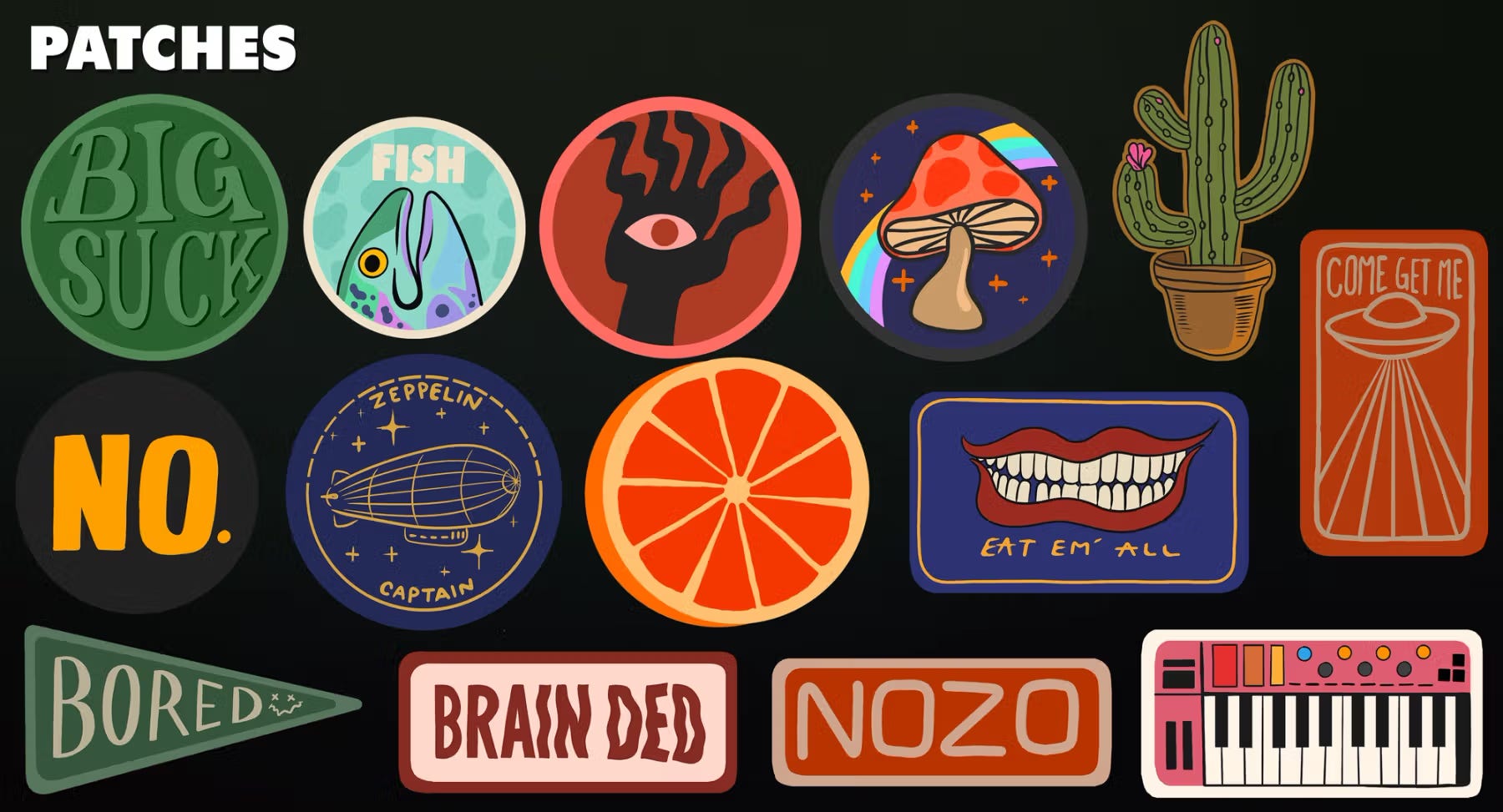
The other big piece of this kerfuffle involves Mixtape’s now-infamous influencer kits. Ahead of launch, Annapurna sent out elaborate swag packages to creators and press, some reportedly with functional CD players. Now, contra the ChudTubers, this is actually fairly standard practice for major releases. But it’s also, when combined with the aforementioned sweeping critical wave, exactly what riles up an audience that’s already primed to suspect a coordinated push.
I do want to choose my words very carefully here, so as to not add fuel to the conflagration in either direction. Because believe it or not, press kits don’t actually buy reviews; major press outlets keep firewalls, and most influencers will straight-up tell you a CD player isn’t going to override their honest read of a game. But the very appearance of an orchestrated push can become its own marketing problem. Remember: in marketing, perception is reality. If your campaign looks like a campaign, audiences will grade it as a campaign. And in a medium where “indie” is supposed to be a virtue signal, polish that obvious will cut against you… or, to put it more plainly: rough marketing looks human, but polished marketing looks like marketing.
Gone Home, Gone Away
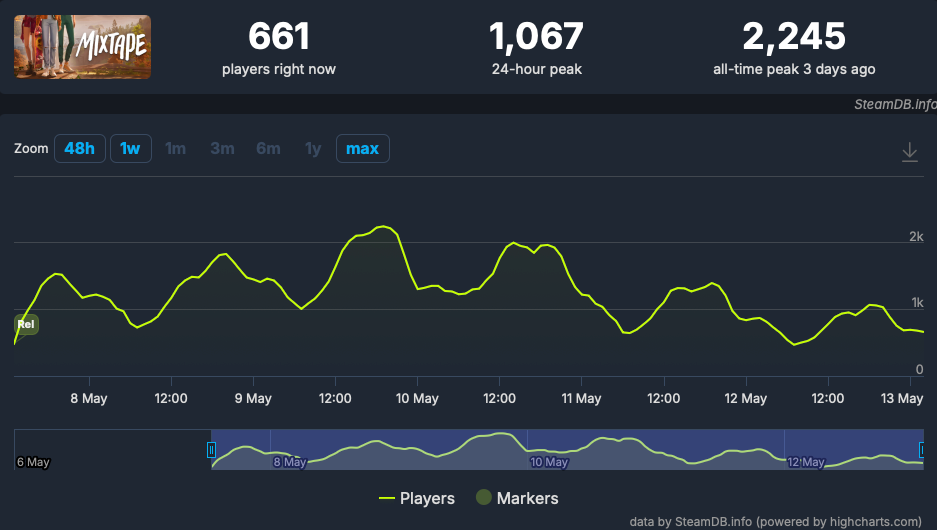
Mixtape peaked at 2,245 concurrent players on Steam and has been trending below that since. That’s a respectable indie number, but it’s a decidedly modest performance for an Annapurna title with this much critical acclaim.
I do want to note an important caveat to these numbers: Mixtape launched Day One on Game Pass, which absorbs a lot of Steam concurrency (because the Xbox-and-PC audience that would otherwise buy on Steam is playing for free on Game Pass). So that 2.2k number is not quite the smoking gun that people are claiming.
But even with that Game Pass asterisk, there’s clearly a significant gap between Mixtape’s critical positioning and the degree of actual player engagement it has received.
This gap is real, and it points towards something far bigger than Mixtape: namely, that the Gone Home-style walking sim / visual novel / interactive movie experience’s moment has clearly peaked. Gone Home, which turbocharged walking simulators into popular acclaim, launched in 2013. Meanwhile, Edith Finch, arguably the genre’s high point, was in 2017… almost a full decade ago.
The market for this genre still exists (hell, even I occasionally dip into it myself), but it’s much smaller in 2026 than it was during the walking sim’s heyday, and it’s not climbing back to those numbers anytime soon. If you’re an indie dev working in this space, you should calibrate your budget, scope, and projections accordingly; don’t model them around outlier titles backed by prestige publishers.
Is “Indie” a Budget, or a Vibe?
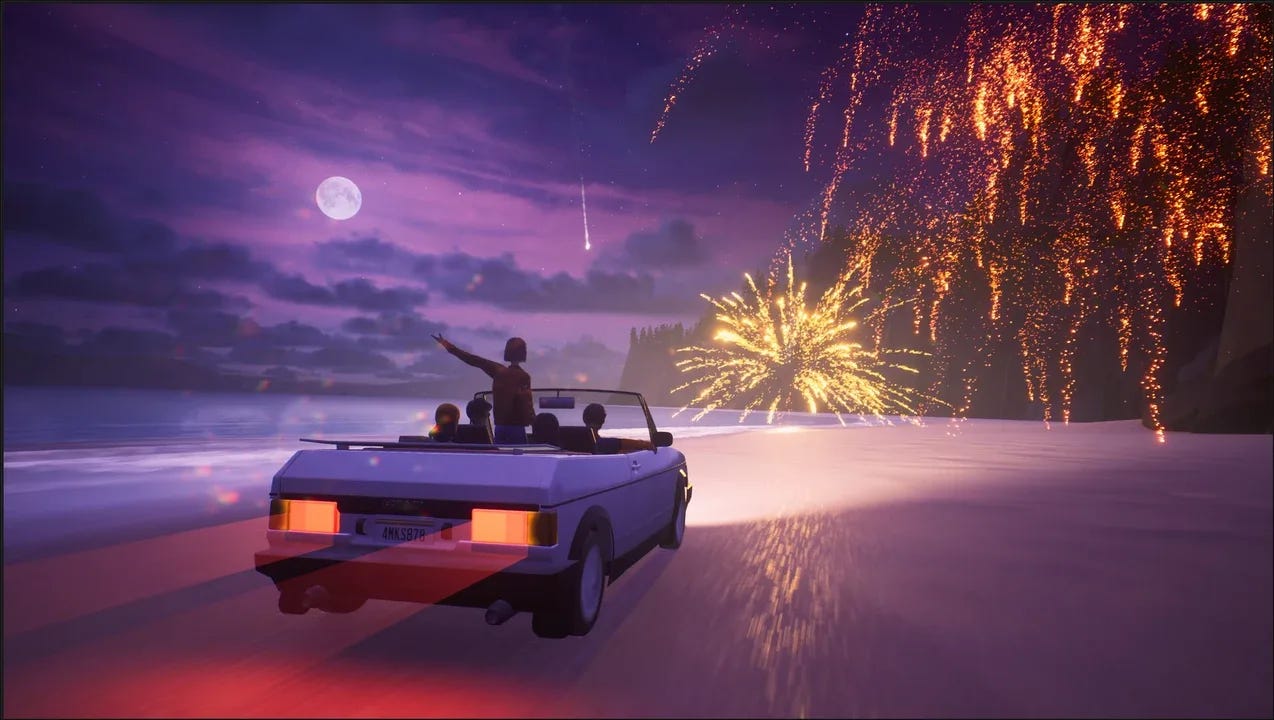
All this chatter also points to another real, and as of yet unresolved, question within the gaming space: what even constitutes an “indie” game or an “indie” developer anymore, these days?
True to its name, Mixtape’s music is the clue that points to this tension: the game’s licensed soundtrack features The Smashing Pumpkins, Joy Division, Iggy Pop, Roxy Music, Devo, Siouxsie and the Banshees, and Lush. That does not constitute an “indie” music budget; only a publisher with serious financial backing, choosing to make a statement, can even dream of inking that kind of licensing.
And sure enough, Annapurna Interactive (which sits inside Annapurna’s broader media empire) was founded by Megan Ellison in 2011. Larry Ellison (Megan’s father) is one of the wealthiest people on the planet. Surely you can connect the dots here well enough.
As a caveat: the publisher suffered a mass employee walkout in 2024 (the entire team resigned and later formed Fictions, Inc.), so the team that shipped Mixtape has largely been rebuilt, like a modern-day Theseus’ Ship. But Annapurna’s financial structure remains intact, and it remains unlike any actual indie’s. And the press relationships Annapurna built over a decade of Outer Wilds, Stray, Kentucky Route Zero (ugh), and Edith Finch don’t reset when staff turns over.
The “nepo baby” critique floating around mostly conflates Annapurna Pictures (the film company Megan runs) with Annapurna Interactive (which she founded but doesn’t operate day-to-day), so it’s mixing up the org charts a bit; this isn’t Megan’s failed high school art project, as funny as the visual undoubtedly is. But there’s a grain of truth in the underlying observation: an “indie” publisher underwritten by Ellison wealth isn’t “indie” according to any structural reality; it’s just using “indie” as a marketing position.
Our game dev taxonomy is long overdue for a hotfix. “Indie” used to signal both an economic structure and creative independence. Annapurna Interactive has the second, but not the first. Neither does Devolver (post-IPO), though Raw Fury and Finji arguably still have both.
Whatever the case, if an indie dev sees Mixtape’s playbook and tries to replicate its swag bags, curated press push, and coordinated embargo without Annapurna underwriting them, they’re only going to incur all of those tactics’ costs without achieving any of their attendant lift.
Don’t Pull a Concord
To close, I want to implore you on one last thing. Yes, I know a lot of the discourse around Mixtape is either sour grapes, misplaced rage, or just plain bad faith. I’m not asking you to engage with the worst of it. But there’s a temptation, when the chuds rise up, to dismiss the entire critique as chud-coded. This is a terrible precedent that the industry foolishly set in the 2010s, and for which we’re still paying today, as it’s clearly still operative in 2026 (if my LinkedIn feed is any indication).
Yes, there’s a lot of noise in the Mixtape discourse, but some of what people are saying contains real signal!
Surely, one doesn’t have to be a “chud” to understand why players are skeptical of yet another critical sweep that doesn’t match player reception or engagement. There are also materially consequential questions about what “indie” even means, on a structural level, in an era where indies regularly outperform AAA in both sales and production value. There’s also a very real frustration with overly lavish press kits that look like coordinated PR pushes. And let’s be honest here: is the wider observation, that the gap between critic and player scores is widening on this kind of title, factually wrong?1
If you refuse to engage with any of that critique and instead dismiss each uncomfortable player concern as irrelevant because it’s coming from “those people,” you don’t actually make the critique go away! You only hand the framing over to whoever’s willing to talk about it... which, in this case, happens to be those dreaded “chuds.” And by the way, this is (roughly) what happened with Concord. It’s not what you want… at least, not if you actually care about selling your game and keeping your studio’s lights on.
If you’re an indie dev without Annapurna’s air cover (which is, to say, practically all of you reading this article), this is not optional advice. You cannot afford a 10/10 in the press and 2k CCU on Steam; all the critical accolades in the world won’t save you if players simply don’t play your game (and the converse is also true; as Stellar Blade proved, you can absolutely survive the undiluted wrath of the press if enough players find our game good enough to purchase).
Let’s face it, getting a great Metacritic score is a much weaker strategic goal than it was even five years ago. If your game isn’t in the genres the modal IGN reviewer is inclined (or, if you’re in a more cynical mood, was hired) to love, you’re likely not going to move that number as much as you’d like, no matter how polished your game is (ask Pearl Abyss if you don’t believe me). But you can move the Metacritic user score, as well as your Steam review score… and those are the ones that matter far more.
Frankly, you’d be much better off skipping the access press altogether and building direct relationships with creators and your community. Which, of course, is precisely what’s been happening over the past few years — as Mixtape has shown, along with Crimson Desert, Black Myth: Wukong, and Stellar Blade before it, the press is now downstream of the audience, not the other way around.
At the end of the day, you can afford to blow off IGN if your game is resonant and compelling enough to players. But you cannot afford to dismiss the players telling you, in plain English,2 what they actually want. They are, in the end, the only audience that pays.
Insert coin to continue,
~Jay
Spawn Point Marketing offers fractional marketing leadership services for indie and AA game studios. For more information, visit https://spawnpointmarketing.com
Ignore the diagnoses of “payola” or corruption for a second here, because the raw observation of there being a gap is undeniably true. If it weren’t, then Crimson Desert wouldn’t have scored a 6/10 while Mixtape scored a 10/10.
As for why this is… what is it, then, if not payola? Well, it harks back to my diagnosis of the gaming press’ mistreatment of Crimson Desert, because both of these games’ scores are downstream of the same issue: gaming outlets, especially the prestige ones, have spent the last decade hiring writers who came up through film criticism, MFA programs, or culture writing pipelines rather than through gaming itself. Those writers are, on average, far more responsive to narrative, mood, soundtrack, and theme (“What is this game saying about adolescence?”) than to things like mechanics, systems, or replayability.
There’s nothing wrong with that lens existing… but when it becomes the house lens, you end up with an outlet that systematically tilts towards rewarding a particular kind of experience: walking sims, narrative adventures, mood pieces… in other words, the exact Mixtape demographic.
So no, this isn’t payola. But in a way, it’s worse than payola, because it’s structural and invisible, making it much harder to rectify. An outlet can always fire a reviewer who takes bribes. But a reviewer who truly, genuinely, and sincerely loves navel-gazing Millennial theatre-kid-coded coming-of-age soliloquys is just doing their job.
Fact is, Mixtape’s 10/10 wasn’t a lapse in judgment… it was exactly the judgment that the reviewer was hired to render, whether or not this was all done consciously. Mixtape is what their taste was trained on; to them, this game really is a 10/10, because their evaluative framework highly prioritizes soundtrack curation, emotional resonance, and aesthetic confidence while deeply discounting mechanical depth and player agency. You don’t have to agree with that framework, but you can recognize that these reviewers hold it sincerely.
In any case, the result looks the same from the outside: a perfect score for the vibes-forward narrative walking sim. And the fixes for each problem are different, too. You can’t audit your way out of this one; you’d have to completely rebuild the bench… and outlets have done the exact opposite for over a decade.
Or Chinese, as is increasingly the case.
Speaking of which, this also connects to my broader East-vs-West thesis. The Western critical apparatus increasingly evaluates games through frameworks it has borrowed from adjacent media like film, theatre, and literary fiction. Eastern studios, meanwhile, largely don’t operate within that critical economy; they’re talking past it, directly to players, by treating the game itself as its primary marketing vehicle.
So the Western press giving Mixtape a 10/10 while giving Wuchang/Stellar Blade/Black Myth: Wukong a 7 isn’t a “conspiracy.” It’s just two value systems looking at different objects through the same lens (which was properly calibrated for only one of them).
It's also worth pointing out that we just had the big debate about 'what is indie' last year, but with a totally different tenor, about Clair Obscur, another game that had a bit more polish and budget than virtually any "real" indie game could hope for, and swept critical reception pretty convincingly, and I'm sure also had press kits and all the rest going on. But, however you feel about the separate "what is a 'real' game" question, I think it contributes too much to the current situation to dismiss entirely - Clair Obscur was, after all, only relatively short by JRPG standards, while a walking sim/narrative experience of the sort that Mixtape is just doesn't have that much for most people to engage with outside of the external, like its reception and drama encircling it. Would Mixtape be a better game, to anyone's sensibilities, if it was also a weird JRPG that took dozens of hours to get through on top of everything else? Looking at YIIK... probably not. But I guarantee it would at least give people things to complain about besides the kissing scene and the press kits.
I love the art. I really don’t like the characters. None of them made me want to encourage them.