
Why Eastern Studios Are Eating Western AAA’s Lunch
And what the indies watching from the sidelines can learn from it all

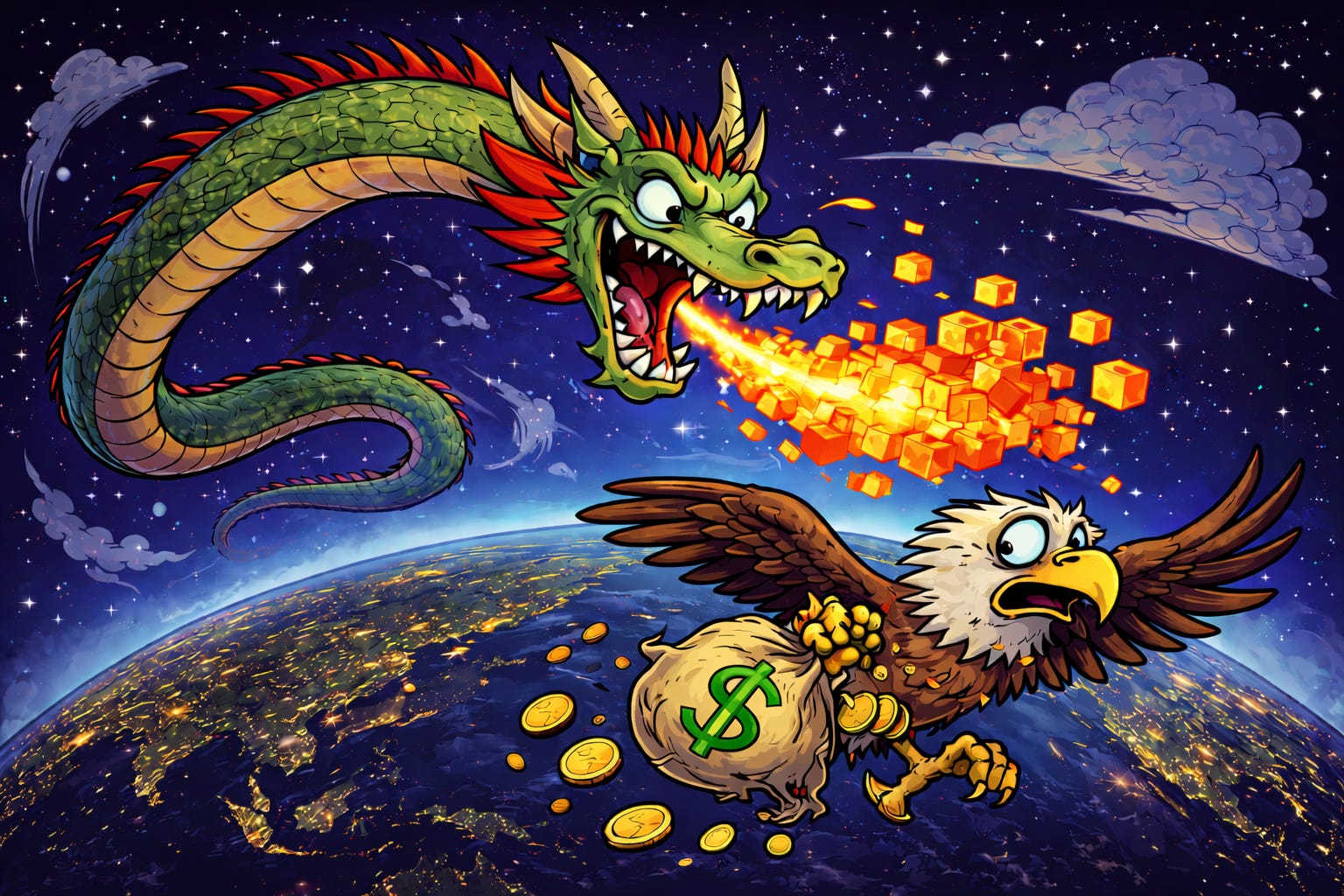
Hey, wanna see a neat party trick? Ok… hold my beer, I’m about to make every Western AAA executive spit out their coffee:
Per Newzoo’s latest forecasts, China is now expected to have passed the United States as the world’s largest video game market by sales, with an estimated $53.2 billion in revenue in 2025. The same year, Chinese self-developed games booked roughly $20.45 billion in overseas sales, up double digits year-over-year. China’s domestic market itself also hit a record $49.8 billion with 683 million players.
This means that, in terms of video games, China’s not “catching up to” to the West, but passing it… if not already passed.
Meanwhile, back in the Western AAA heartland, the industry has shed roughly 45,000 jobs since 2022. The 2025 pace finally slowed from 2024’s catastrophic ~14,600 layoffs, dropping to somewhere around 6,200 to 9,700 (depending on who you ask), which is “less brutal” only in the sense that a slower-moving bus still runs you over.
On a more macro level, EA is restructuring into two franchises amid a Saudi PIF-led buyout, while Ubisoft has torn itself into five “Creative Houses” after 1,200 employees walked out on strike.1 Embracer went from 15,701 employees to less than 7,000 while closing or divesting 44 studios, and Warner Bros. Games hasn’t had a games division president for over a year.
And in the middle of all that carnage, a debut studio from Hangzhou called Game Science dropped Black Myth: Wukong on August 20, 2024, moved 10 million copies in 83 hours, hit 2.4 million peak concurrent on Steam, and went on to sell over 25 million units to date. That’s just one game from one studio, clocking the kind of debut performance most developers can only dream of, all built around a distinctly Chinese mythology of the kind that Western publishers spent years telling each other “wouldn’t travel.”
Oh, but it traveled, all right. It traveled very far indeed.
And then, on March 19, 2026, Seoul-based Pearl Abyss shipped Crimson Desert: a seven-year, $133 million open-world action-adventure that moved 2 million units in its first 24 hours and crossed 5 million within one month. Now, this was a different type of game in a different (if somewhat adjacent) genre than Wukong, made by a different studio in a different country, operating under a different design philosophy. Nevertheless, it told a similar story (you could say it was simply the next chapter in said story): an Eastern team made the game they wanted to make, at the scale they wanted to make it, and the global audience showed up for it in droves.
(I wrote about Crimson Desert‘s reception a few weeks back, and its sustained post-launch numbers continue to vindicate my read. Far from an outlier, Pearl Abyss proved that this is, without a doubt, the new normal.)
So, what is actually happening here? And no, it’s not simply “China is rising”; that’s the lazy take, and it glosses over the most important lesson for the indie folks reading this newsletter.
Eastern Studios Figured Out What Western AAA Forgot
The easy explanation is that Chinese, Japanese, and Korean games are winning because they’re cheaper to make, their development cycles are shorter, or their studios are backed by their respective governments. And sure, some of that’s true at the margins… but it’s not the real story.
The real story is that the biggest Eastern hits from the last three years were built by people who still believed the game itself was the marketing’s main driver.
Game Science didn’t win because they had a bigger UA budget than Ubisoft, but because they spent six years making a more visually and mechanically compelling game than all of Ubisoft’s recent catalog put together, so much so that a single trailer in 2020 drove more wishlists than most AAA launches manage across an entire campaign.
Similarly, it’s not like Crimson Desert sold five million copies in 27 days because Pearl Abyss executed a particularly inspired performance marketing campaign; they ultimately did it because they spent seven years of patient development creating a world players wanted to live in, which provided the fuel and the foundation for its marketing to do the work (indeed, their pre-launch marketing arc and post-launch community management were both impeccably well-executed, and they certainly accelerated the game hitting its sales milestones so quickly!).
Finally, Hoyoverse didn’t conquer global mobile with just a clever funnel (though they certainly employ one!); in order for that funnel to work, they needed to make Genshin Impact feel like a console RPG your friends actually wanted to talk about, while also building a well-oiled operational engine that constantly ships new content — at a cadence Western live-service teams still can’t match.
Oh, and let’s not forget Japan — long one of gaming’s most economically significant and culturally influential markets, towards which gaming communities worldwide still feel a deep reverence and affinity for — which had its all-time record year in 2024 at ¥2,396.1B (~$16.2B), and the 2025 data so far indicates its momentum remains strong. Capcom, FromSoftware, Square Enix’s internal teams, and Nintendo all kept their hands on the craft, which their sales figures reflect.
Oh, and speaking of Nintendo… did you know that Nintendo of America promoted its top marketing executive, Devon Pritchard, to President? Stop for a second to think about what that means: a marketer now runs Nintendo of America. Now, contrast that with Microsoft completely eliminating the Xbox CMO title and fragmenting marketing across four reporting structures. The Japanese company treats marketing as strategic leadership, while the Western company treats it as a line item to restructure… with predictable consequences in both cases.
Now, just so I’m being completely honest about the full picture… I’m not saying the Eastern path is a guaranteed win. As a cautionary counterpoint, consider Wuchang: Fallen Feathers, which shipped from Chinese studio Leenzee in July 2025 with very high hopes indeed; its epic scope, fun and tactical Souls-like combat, and pristine visuals (including beautiful level and character designs) promised an experience that could equal or even surpass Wukong.
But unfortunately, the game underdelivered on technical polish and then got mercilessly review-bombed: first by its own domestic audience over how it portrayed certain historical elements (albeit in the opposite direction as similar controversies in the West), and then by international audiences as the changes Leenzee made in response all but ruined the gameplay experience.
As of this month, the studio has effectively disbanded in the midst of pending lawsuits and unpaid wages to its staff. So as you can see, Eastern publishers are not immune to bad launches, they’re just as capable of misreading their audiences as Western publishers, and they’re just as beholden to modern game development’s brutal economics as everyone else in the industry.
So before you “what about” me in the comments, understand that I’m not claiming every Eastern game succeeds. But I am saying that Eastern studios are increasingly producing gaming’s breakout hits, and the industry’s creative center of gravity has accordingly shifted towards them. The fact that outliers exist does not disprove the general trend.
Meanwhile, the Western AAA playbook drifted to a grim and ugly place over the past decade, and especially throughout the past five years. Far too many Western publishers spent the 2010s and early 2020s optimizing for quarterly earnings calls, chasing live-service unicorns, layering monetization onto games that didn’t need it (and whose players didn’t want it), and building 400-person teams that couldn’t ship a coherent vision because nobody owned one.
As a result, playtime in the six major Western markets is down in 2025. Free-to-play playtime fell 8.1% on PC, 4.3% on PlayStation, and 11% on Xbox year-over-year. Even Call of Duty playtime dropped 59.4% (!!!) on PC.
Something is deeply, deeply wrong here.
A Disconnection Most Structural
If you want my honest read on the deeper issue, it’s that Western AAA is struggling because it became structurally disconnected from the people who play its games, whereas Eastern studios, for a bunch of reasons (whether cultural, organizational, or just happy accidents of geography), stayed closer to their players. Just ask Hoyoverse’s community teams, who are legendary for the depth of their signal processing. Or consider how Japanese studios run on a director-centric model, where one creative voice carries a game from pre-prod through post-launch… or, for that matter, the way Korean MMO teams live and die by their guild-level feedback loops (in case you didn’t know, Pearl Abyss was originally an MMO studio, hence why they were able to patch Crimson Desert‘s control scheme, AI art issues, and difficulty curve — all in direct response to community feedback — within days of launch).
Western AAA, by contrast, built layers upon layers on top of more layers, with a few extra layers on top of those layers. Western productions became a Kafka-esque amalgamation of research agencies, focus groups, and just about every flavor of consultant imaginable for each conceivable function (and more than a few novel ones, for good measure). Leadership erected siloes for publisher marketing, platform marketing, first-party marketing, and so on and so forth, while outsourcing community management to three different vendors. I could go on, but you get the idea.
With each added layer, the people making the game pushed themselves farther and farther away from the people playing the game. And when you’re that far away from your audience, you simply stop hearing what they’re actually telling you. Instead, you start hearing what your deck says they should be telling you, thinking it’s the same thing.
When you strip everything down to its most fundamental level, that’s really why so many post-launch live-service corpses litter 2023, 2024, and 2025. It’s why Concord even happened to begin with, as well as why Highguard shut down before it ever had a real chance — indeed, as Highguard taught us, good marketing can’t save a bad product-market fit. If anything, it accelerates failure when the product is fundamentally disconnected from its audience. And Western AAA, as we’ve just examined, has spent the better part of the last two decades building the most efficient audience disconnection machine in entertainment.
Can it get better? Sure. But the question is… who will do it, after so many people got cut?
Because unfortunately, and no matter how much we’d love for it to be, 2025’s slowdown in layoffs is most likely not a recovery signal, but the endpoint — the grim aftermath of companies having already cut everyone they were going to cut. The structural damage is already done; the 45,000 jobs lost since 2022 represent around 100,000 years of accumulated industry experience walking out the door, per the estimates Amir Satvat has been tracking.
That’s not something you can just rebuild in a fiscal year… or even a fiscal decade.
How the Western Industry Can Start Adapting (If It Wants To)
But as you know, I don’t try to be a doomer. I fundamentally believe that every situation, no matter how grim, is solvable. The right solution may not be easy, quick, or pleasant, but a solution it still is.
So, what’s the solution here?
Well, first off, I’m not going to pretend I have a specific, comprehensive turnaround plan for EA. Because I don’t. But the way I see it, the overall playbook for a Western AAA recovery isn’t actually a mystery, and it’s really quite feasible. It starts with the following steps:
I. Cut layers, not headcount. The knee-jerk response to a brutal market is layoffs, and the Western industry has done plenty of those. But what it hasn’t done is flatten the structural distance between studios and players. Ubisoft’s Creative House model is an attempt at this... we’ll see if it sticks.
II. Put creative leads back in charge of their games’ identities. Marketing works when it’s downstream of a clear vision, and flounders when it’s a committee trying to reverse-engineer a narrative for a product nobody owns.
III. Stop chasing the live-service lottery. The live-service graveyard is overcrowded and deep, with a brutal hit rate. And most tragically, the opportunity cost of every failed live-service attempt is the single-player or co-op bestseller you didn’t make instead.
IV. Take Eastern studios seriously as creative peers, not just as licensors or competitors. Wukong, Crimson Desert, Genshin, Elden Ring, Metaphor: ReFantazio, Stellar Blade, and Monster Hunter Wilds are not regional anomalies. The studios behind them have become gaming’s new center of gravity.
After that, it’s execution all the way. We can disagree on the details there. But I’m very hard-pressed to see how any attempt could land or sustain itself long-term without starting from all of the above four principles.
What Should Indies Do?
Now, finally, we’ve arrived at the good part: advice for the people I work with every day.
If you run a 15-person indie studio, Western AAA’s marketing credibility collapse is your biggest opening since the indie path first became viable. Players are practically starving for games made by people who actually seem to care. The bar for games “made with love” is lower than it’s ever been because there’s just not a lot out there (relatively speaking) to compare against, which is quite sad for the industry at large but potentially great news for you... if you play your cards right.
Here are a few things I’d have every indie team internalize right now:
1. Your proximity to your players is a competitive moat. You’re not EA, which means you can actually read every Discord message, respond to every forum post, and truly talk to the people playing your game. DO IT. That’s a massive structural advantage that Western AAA has all but softlocked itself out of.
2. Wishlist velocity still matters more than total wishlists. The GameDiscoverCo newsletter and every serious analyst will tell you (correctly) that the shape of your wishlist curve in the 30 days before launch is the single best predictor of your game’s opening-week performance. As far as marketing problems go, that’s surprisingly straightforward to move the needle on, and it starts with a little pre-production discipline.
3. Study Eastern studios’ patience. Game Science took six years on Wukong, while Pearl Abyss took seven on Crimson Desert. Hoyoverse similarly spent several years building internal tools before they could ship at their current cadence. The surest path to a great launch starts in pre-production (which, if you’ve been reading this newsletter for a while, is a drum I beat every week for a reason).
4. Don’t confuse a marketing budget with a marketing strategy. Western AAA is a cautionary tale about what happens when you have plenty of the first and none of the second. Indies have the opposite problem, which is actually easier to fix.
5. The “it won’t travel” excuse is dead. Whatever genre, setting, mechanic, or cultural specificity you’ve been told is “too niche for the global market”? Wukong buried that argument with Chinese mythology, Crimson Desert salted the grave with the type of open-world fantasy that gaming pundits declared was fully played out, and Stellar Blade poured concrete on top with fanservice-tastic character designs that Western publishers would’ve killed in pitch (and which Western games media actually tried to kill before launch). Make the game you actually want to make, and find the audience that actually wants it. Everything else is noise.
Listen, I know I’m hard on Western AAA in these pages, but I’m actually not rooting against them. Some of the best games of my life came from those studios, and a lot of talented people are paying the price for disastrous decisions they didn’t make.
But we do need to understand, with clear eyes, this new reality we now live in: China is now the world’s largest gaming market, Chinese studios are exporting $20 billion a year in games, a Korean studio just sold five million copies of an open-world RPG in less than a month, and the industry’s biggest breakout titles are increasingly coming out of studios most Western executives couldn’t have named three years ago. It’s clear as day that the center of creative gravity has shifted, and pretending otherwise doesn’t help anyone (least of all yourself, if you’re a Western AAA exec who happened to read this article).
The good news, if you’re an indie or AA studio founder reading this, is that this shift is in your favor, regardless of where you’re located. Players don’t actually care where your studio was founded or operates; they’re simply hungry for the types of experiences that AAA has systematically neglected, and as a result, they’re rewarding craft, responsiveness, and honest ambition more than they have in a decade.
The Eastern studios figured that out first… but you can be next.
Press Start,
~Jay
Spawn Point Marketing offers fractional marketing leadership services for indie and AA game studios. For more information, visit https://spawnpointmarketing.com
We’ll set aside the fact that Tencent (you know… a Chinese publisher) is basically bailing Ubisoft out following a string of underperforming (at best) and downright disastrous (at worst) launches over the past few years.
The Western AAA industry is cooked if they dont wake up.
Great breakdown! I also hope that these developments open a path for more indie projects. Over the past decade, the single player FPS genre has already gone through somewhat of a revival thanks to bold indie devs (Dusk, Ion Fury, Selaco). I hope that other genres can follow in picking up the pieces where Western AAA collapsed in on itself.
In terms of AAA, over the past months I've mainly been playing games by Koei Tecmo, Nintendo and HAL Laboratory. One thing I noticed is the relative lack of bullshit in their products. Little after-purchase monetization, no need to make extra accounts or install several layers of DRM, and a near total absence of bugs because these products weren't rushed past the finish line. Just put the game in the console and have fun. It's so refreshing.