
Three Simple Steps to Launch Readiness
Ready Check #10: The Launch Readiness Series
This is the tenth article in Ready Check, a weekly series of 12 articles on launch readiness for indie and AA games that serves as a companion compendium for my Game Launch Readiness Scorecard. While each individual piece focuses on themes and provides tips that stand on their own, they also build on and reinforce each other, so I recommend reading them in order. To catch up, start here:

New installments of Ready Check will drop each Monday at 7:00 a.m. Pacific Time. If you haven’t already, be sure to subscribe to Spawn Point Marketing so you don’t miss any:
We’ve covered a lot of ground in Ready Check, haven’t we? Over the past nine weeks, we’ve broken down the six categories of your game marketing engine:
You now understand what each one measures, and why I’ve weighted everything the way it is (if you don’t, you may want to give the series another read before coming back to this tab!). So this week, I’ll show you how to read your results, and how to actually act on them.
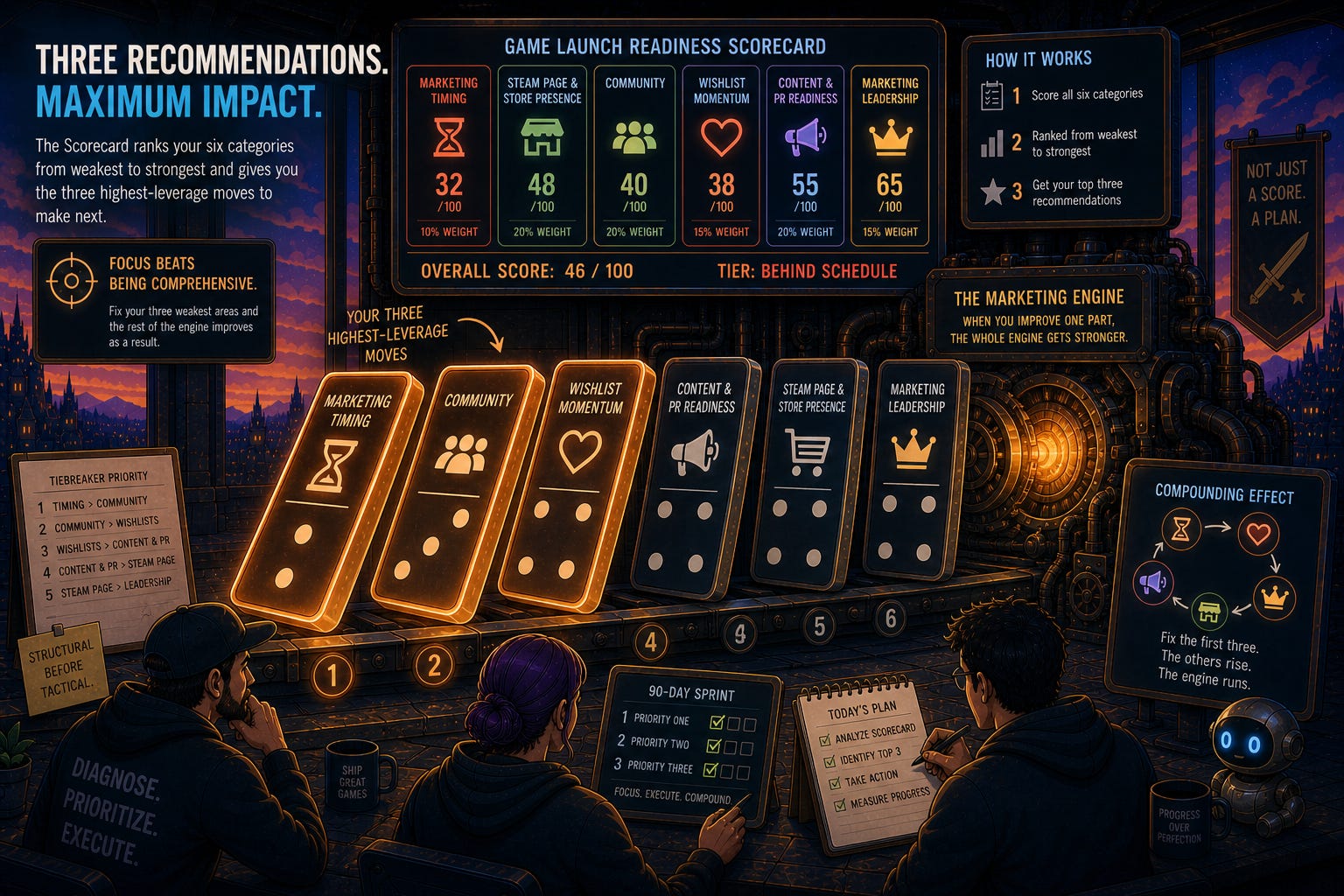
Because after all, in any assessment, a score without a next step is just a number. That’s why the Game Launch Readiness Scorecard doesn’t stop at your score and tier! It also generates three specific recommendations to buff your launch readiness. In this market, you need all the help you can get, which is why I built the Scorecard to give you the three highest-leverage moves you can make right now, based on where you’re currently weakest.
How the Scorecard Picks Recommendations
The Scorecard’s recommendation logic is actually quite straightforward: it simply ranks your six category scores from lowest to highest. Your first recommendation comes from your weakest category, your second comes from your second-weakest, and your third comes from your third-weakest.
If two categories are tied, the tiebreaker follows a priority order:
Marketing Timing beats Community
Community beats Wishlists
Wishlists beats Content & PR
Content & PR beats Steam Page
Steam Page beats Leadership
That priority order reflects the Scorecard’s compounding logic, which I’ve gone over at great length throughout this series; namely, it surfaces structural categories first, mostly because they’re more impactful (and more load-bearing, and because they take longer to fix).
Within each category, your answers determine which specific recommendation you receive. So, for example, if you scored low on Community because you have no Discord, you’ll get a different recommendation than if you have a Discord but no email list… similarly, someone who scored low on Marketing Timing because they haven’t started yet will get a different recommendation than someone who has started but has no written plan.
As a result, instead of more generic “do more marketing” advice, you get three actionable recommendations, specific to your situation. These are concrete next steps, tied to the gaps your answers revealed, that you can act on right away!
Why Three Recommendations, not Six?
The Scorecard evaluates you across six categories, and you might be weak in four, five, or even all six of them. So why only show three recommendations?
Because I believe that, at any given moment, focusing on the bigger problems beats comprehensively covering all the problems. If you try to fix everything all at once, you’ll usually end up fixing nothing (because you’ll spread yourself too thin… especially if you’re a solo dev or running a small team). Three action items, on the other hand, constitute a much more manageable scope. Remember, these are recommendations for a 90-day sprint, not a massive 12-month overhaul.
And in most cases, fixing your three weakest areas often creates positive cascading effects that end up raising the other categories, even without any direct intervention!
But why does that happen? Well, because the six categories don’t operate in a vacuum; they’re interconnected pieces of a marketing engine. If one piece of the engine falters, it drags the rest down… but the inverse is also true, and fixing one part will end up buffing the others. For instance:
Fixing Marketing Timing by getting a plan in place makes it easier to fix Community, because now you know what channels to invest in.
Fixing Community by building a Discord and starting an email list, in turn, makes it easier to fix Wishlist Momentum because you now have active channels driving organic wishlists.
And fixing Content & PR by building creator relationships indirectly lifts your Steam Page score, because creator traffic tests your page’s conversion rate and forces you to optimize it.
The Scorecard just gives you the first three dominoes; if you knock those over, the others will often follow.
The 4 Most Common Result Patterns
Yup, you guessed it! It’s that part of each article again where I go over the patterns that emerge after seeing enough scorecard results. But I’m going to switch it up a bit this week! Instead of three examples, here are the four profiles I see most often, and what the recommendation stack typically looks like for each:
1. The Builder Who Hasn’t Started Marketing
Score Range: 25-45 🔸 Tier: Flying Blind or Behind Schedule
This studio has a game in production and well underway (maybe a vertical slice, or in alpha) but has done essentially no marketing work. The game either has no Steam page, or one that’s been up for a few weeks and hasn’t been optimized. The studio also hasn’t set up any community infrastructure, and isn’t conducting outreach. Basically, the game itself is at Level 50, while marketing is still at Level 1.
A typical recommendation stack for this studio is:
Start marketing this week; define who your player is and where they spend time.
Get your Steam page live this month.
Start a Discord and begin collecting email addresses.
The timeline for this studio to fix its problems is 3–6 months, which harks back to why the Scorecard’s tiebreaker prioritizes Marketing Timing to heavily; this studio needs to lay the structural foundation before anything executional can work, and laying the structural foundation takes time… lots of it, in fact!
2. The Pollyanna With No Wishlists
Score Range: 45-65 🔸 Tier: Behind Schedule
This studio has done some marketing; its Steam page is live, maybe it has a small Discord along with some social presence. But its wishlist momentum is very weak, and it hasn’t started reaching out to creators. It also hasn’t written a full GTM plan. But hey, at least it’s something, right? And it’s true that the team is doing things… it’s just not doing the right things, or in the right order. Unfortunately, that’s not enough for a strong launch. Not in 2026.
A typical recommendation stack for this studio is:
Write a go-to-market strategy before spending another dollar on tactics.
Start building your content creator outreach list right now.
Focus your marketing energy on the three highest-leverage wishlist drivers for indies: Next Fest, creators, and Steam page optimization.
This is the most common profile I see, and the good news is, it’s also the most responsive to intervention. And that’s because these studios are already in motion; instead of starting from zero, they just have to reorient efforts they’re already expending.
3. The “+1 Community / -1 Strategy” Studio
Score Range: 55-75 🔸 Tier: Behind Schedule or On Track
This studio already has an engaged community; they’ve got a solid Discord and an active social presence that oozes palpable fan enthusiasm. But the studio has no formal marketing leadership or a GTM document, and the game’s low wishlist momentum (especially relative to its community health) suggests that the community, active as it is, just isn’t converting to store page visits.
A typical recommendation stack for this studio is:
Hire a marketing lead; someone needs to own marketing as their primary responsibility.
Write a go-to-market strategy that maps your community strength to activities that drive conversion.
Optimize your Steam page; your community is sending people there, but the page isn’t converting them.
This profile is the most frustrating for founders because their active and buzzing community feels like proof that their marketing is working. And it is working… somewhat. Partially. But the game’s missing a conversion layer, and that is a ticking time bomb that’s primed to catch everyone off-guard at launch. But if fixed, that conversion layer would defuse the bomb by transmuting their community’s enthusiasm into measurable pre-launch traction and, come Day One, into strong sales.
4. The Studio Performing a Ready Check1
Score Range: 70-89 🔸 Tier: On Track
This studio has done the most things right: their game has a strong Steam page, their wishlists are growing at a healthy clip, their community flywheel is starting to spin, and creators are responsive to their pitches. For this tier, gaps usually appear in one or two specific areas that vary by game and studio; maybe there’s no email list, or no press kit, or maybe the founder is still the sole marketing owner.
The recommendation stack for this profile similarly varies, but it usually targets the one or two gaps that still remain. At this level, the Scorecard’s recommendations become more incremental rather than structural in nature; for instance, starting an email list rather than starting marketing at all. The Scorecard’s value for this profile lies more in confirming what’s working and finding the remaining gaps; these studios often know they’re in decent shape, but want to make sure they’re not overlooking anything.
A Quick Note on Post-Launch and Non-Steam Studios
The four profiles above describe pre-launch studios on Steam, which is the most common scenario I encounter. But the Scorecard also adapts for two other situations:
If you’ve already launched, the recommendation engine shifts its framing, replacing pre-launch urgency language (”narrow your launch window,” “accelerate wishlists before launch”) with post-launch equivalents: reigniting momentum through content updates, optimizing for sale event conversions, and building creator relationships around your next major patch or DLC. The Scorecard swaps out the Next Fest question for one on post-launch marketing cadence, and reframes your wishlist backlog as deferred revenue that converts during sales events (instead of as a launch-day conversion pool).
If you’re not on Steam (whether because you’re console-first, launching on mobile, or using a different PC storefront), the scorecard replaces Steam-specific questions with platform-generic equivalents. But make no mistake: you still need to optimize your page, and measure pre-purchase intent (whether through App Store pre-orders, PlayStation Store follows, notification sign-ups, or whichever metric is best for your primary platform). The principles remain the same regardless of where you launch; only the specific platform vocabulary changes here.
Obviously, both of these states produce different recommendation stacks than the profiles above. The Scorecard handles this automatically, so you don’t need to translate the advice yourself. Easy peasy!
How to Sequence the Three Recommendations
The Scorecard orders recommendations by urgency, but urgency and sequence aren’t always the same thing! Here’s how to think about the order in which to execute your recommendation stack:
If your first recommendation is structural (start marketing, write a GTM plan, assign marketing leadership, etc.), do it first. Don’t skip to recommendation #2 because it feels more actionable! Structural recommendations exist because the Scorecard detected a missing foundation, and if you build tactics on top of a missing foundation, don’t be surprised if you end up shutting down four months after launch.
If your first recommendation is executional (optimize your Steam page, build a press kit, start creator outreach), you can often run recommendations #1 and #2 in parallel, because executional work doesn’t depend on sequence like structural work does.
If your three recommendations span structural and executional, do the structural one first, even if it’s listed second or third. The ordering reflects your score’s severity, but in practice, the structural fix enables any executional fixes to work at all!
A reasonable timeline for most studios is to spend weeks 1-2 on the structural recommendation (define audience, write GTM plan, assign marketing ownership, etc.), then spend weeks 3-8 on executional recommendations (optimize page, build outreach list, launch community channels, collect emails, etc.), and weeks 9-12 measuring results and retaking the Scorecard to see what moved.
Retaking the Scorecard
Yes, you read that right… the Scorecard is designed to be taken more than once! In fact, your score will change as your marketing infrastructure develops. A studio that scored 35 in January might score 60 in April after executing on their three recommendations, and the new score will then generate three new recommendations… which will be different because the gaps will have shifted.
I recommend retaking either every 90 days or after any major marketing milestone (you launched your Steam page, presented a demo at Next Fest, rode your first creator coverage wave, released a new trailer…). Each retake will give you an updated diagnostic and a fresh set of priorities, so I encourage you to keep checking.
Over time, your pattern should show a rising score with shrinking gaps between categories. A healthy trajectory looks roughly like this: 35 ➡️ 55 ➡️ 70 ➡️ 80+. The first jump is usually the biggest because structural fixes produce outsized gains, while later jumps become smaller and more incremental. That’s totally normal and to be fully expected.
What the Scorecard Can’t and Won’t Tell You
As useful as the Scorecard is, it’s not a crystal ball. Specifically, there are three things it can’t tell you, because it’s not designed to:
Whether your game is good. The Scorecard measures marketing readiness, not game quality. A mediocre game with perfect marketing will underperform just as much as a brilliant game with poor marketing readiness; it will just log better Week One numbers before negative reviews kill its momentum. The Scorecard assumes you’re building something worth playing; if you’re not sure about that, the Scorecard won’t help, because you need a different type of diagnostic altogether.
Whether your market exists. The Scorecard also doesn’t evaluate product-market fit. In other words, it doesn’t ask whether anyone even wants a “farming roguelite with time travel mechanics.” That’s a positioning question; it lives way upstream of everything that the Scorecard measures, and is determined long before any marketing is executed. If you’re not confident your game has an audience, I do offer a Speedrun Strategy Session that’s designed (among other things) to answer that question before you further invest in marketing infrastructure (more details later).
Whether you should launch now or delay. The Scorecard gives you a score and recommendations, but it can’t render a verdict on whether to launch or not. A low score doesn’t necessarily mean you should delay; it might mean you should launch and accept less initial revenue while you build the infrastructure for your next title. Likewise, a high score doesn’t mean you should launch immediately; it means your marketing readiness is strong… but production readiness is a different beast altogether, far outside of the Scorecard’s scope.
The Scorecard is but one diagnostic. A useful one, to be clear! But it sits inside a larger context that includes things like your financial position, team capacity, competitive timing, and risk tolerance. The three recommendations help you prioritize within the marketing domain, but you need a broader and more holistic view to make the final launch decision itself.
When Three Recommendations Aren’t Enough
There are situations when three recommendations just don’t cover it, and sometimes the Scorecard surfaces a deeper systemic problem. A studio that scores below 30 across four or more categories is dealing with more than just a few gaps; these folks are outright missing an entire marketing function.
For those studios, the three recommendations form a workable starting point, but the real intervention is structural in nature: someone needs to own their marketing strategy end-to-end, build the architecture that the Scorecard measures, and sequence the work across a 6-12 month timeline.
Fortunately, that’s exactly what a Speedrun Strategy Session is designed to do! During a focused half-day engagement, we build you a complete plan: positioning, audience definition, marketing beats, channel strategy, timeline, and KPIs, all tailored to your game, your team, and your launch window! It’s the full version of what the three recommendations sketch an outline of.
If your Scorecard shows three recommendations that you can execute on your own, do that. The Scorecard did its job! GG, go get ‘em, come back in 90 days and see where you are then.
But if your Scorecard shows a systemic gap that three recommendations can’t close, you don’t need a diagnostic. You need a strategist.
Take the Game Launch Readiness Scorecard →
Book a Speedrun Strategy Session →
Next Week: We’ll examine what “Launch Ready” truly looks like, and the patterns that separate studios that score 90+ from everyone else.
GG,
~Jay
Spawn Point Marketing offers fractional marketing leadership services for indie and AA game studios. For more information, visit https://spawnpointmarketing.com
Title drop!