
You Can’t Shadow Drop a Delay
What Amazon's Tomb Raider Gaffe Can Teach Indies About How NOT to Announce a Delay

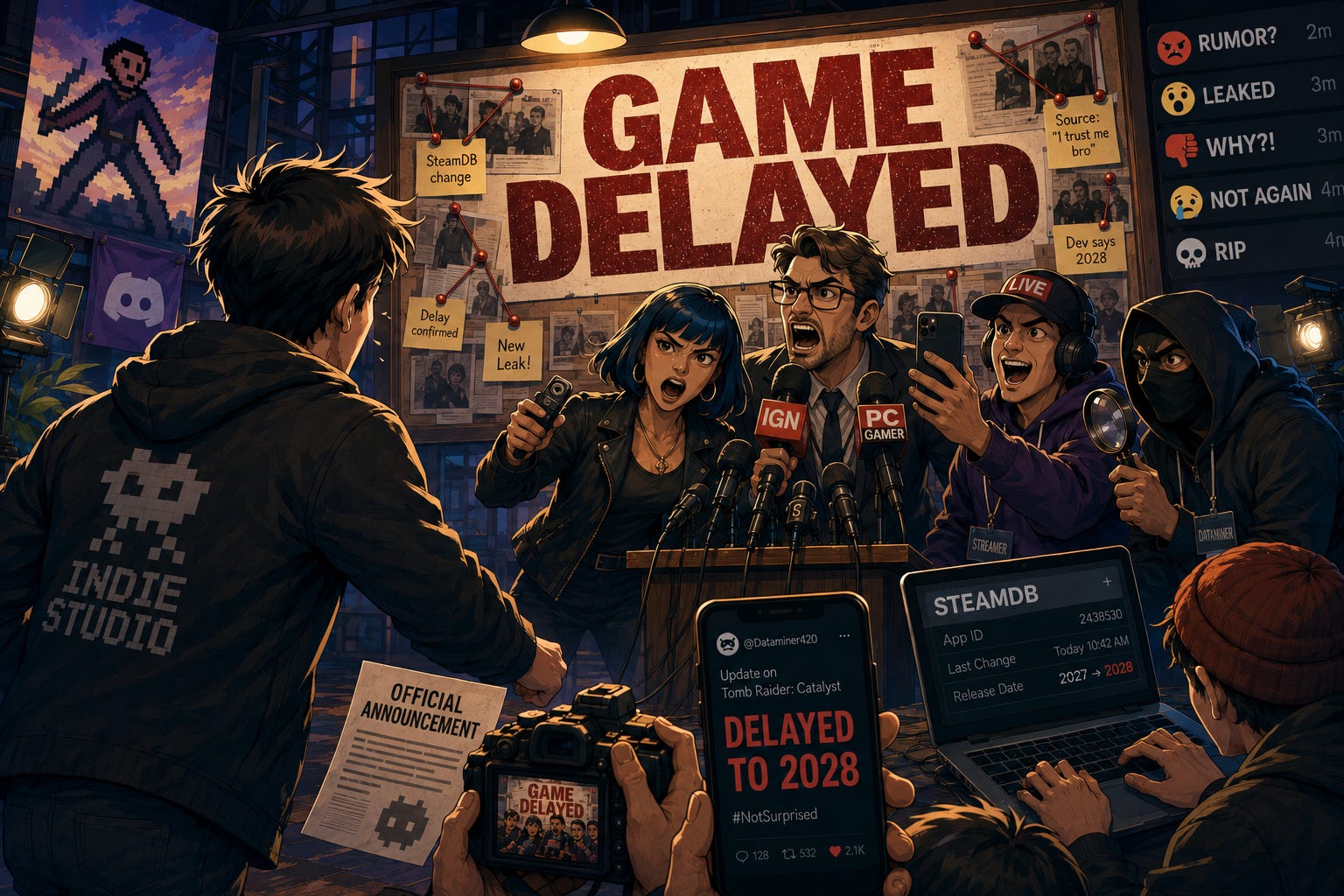
ED NOTE: A scheduled article accidentally went out to some of you on Thursday. I’d meant to send it out next week, and barring any ground-breaking industry news until then, that’s when you’ll receive it for real. Apologies for any confusion caused by my false start!
TL;DR: Your game IS going to slip. And when it does, you have three options: announce it yourself, let it leak out sideways, or say nothing and cross your fingers nobody checks the calendar. Only one of those deposits trust in your reserve… the other two withdraw from it, and one of those withdrawals even compounds. Amazon just gave us a live demonstration of letting it leak sideways, and because you don’t have Amazon’s cash pile or 30 years of Lara Croft goodwill to absorb the hit, you need a delay disclosure policy now, before you have to announce it. I’ll give you the framework at the end, so pay attention!
The Curious Case of The Delay that Announced Itself
On July 23, Amazon Games boss Jeffrey Gattis sat down with The Game Business for an interview, where he mostly talked about Luna (Amazon’s cloud game streaming service) landing inside the Prime Video app. Somewhere in the middle of a question about how Amazon splits its investment between AAA and indie titles, he said this:
“We have obviously announced the two Tomb Raider titles. Tomb Raider Legacy of Atlantis comes 12 February, next year, and then we’ll follow on in 2028 with the next one. We’re excited about those.”
Did you catch it? Let’s take a second look at that quote:
“The next one” that he’s referring to is Tomb Raider: Catalyst. When Amazon and Crystal Dynamics first unveiled it at The Game Awards in December 2025, their announced release window was “2027.” So Gattis just pushed a flagship AAA title back a full year… in a subordinate clause… during a podcast about a streaming app.
As of this writing, Amazon, Crystal Dynamics, and the platform holders still haven’t formally announced the delay, and as of the time I’m writing this, Amazon’s own website still lists Catalyst as coming in 2027. But Gattis spoke, and in doing so, gave us different information about the game’s launch dates… and since it’s now the most recent information to come out of the platform, the press was more than happy to run with it.1
Now, will Tomb Raider survive this? Yeah, obviously. DUH. Lara Croft has survived tank controls, three reboots, and that one godawful movie with the bungee ballet scene. A brand with three decades’ worth of equity and Amazon’s balance sheet backing it can absorb a sloppy delay reveal, much in the way a Level 80 paladin can absorb a goblin’s dagger.
You, however, are not a Level 80 paladin. You’re an indie studio whose community trust is probably the single most valuable asset (if not the only valuable asset) you own before launch. So let’s talk about your three realistic options when a date slips… because one of them will slip eventually, and whether you handle it well or handle it like Amazon just did will directly affect both your wishlists (today) and your sales (at launch).
Option 1: Announce It Yourself (Clearly, and With a Reason)
This is when you rip off the proverbial Band-Aid. You write the delay announcement yourself, you name the new window (or you forthcomingly admit that you don’t have one yet), you give a reason for the delay, and you publish it on your own channels before anyone else can frame the delay for you.
Let’s not suguarcoat it: there IS an immediate cost to this. Players will be mad at you! For a while! Your Discord will light up with invective, salty players will fill your announcement replies with clown emojis, and someone will inevitably comment “dEaD gAmE!!1!!” on a project that is very much alive. But that sting lasts roughly a week or two in most cases, and then something interesting happens: all that anger metabolizes into a weird kind of respect.
Longtime readers will remember the Trust Reserve Model that I’ve harped on at length in these pages: trust is a currency, and your community is a bank account. Devlogs and honest updates are deposits, and launch day is a massive withdrawal. A self-announced delay might well be the strangest transaction in that ledger… it’s a withdrawal that eventually converts into a deposit. Players take a clear and reasoned delay announcement as evidence that you’ll tell them the truth, even when telling the truth is painful or inconvenient. And that’s often all the evidence they’ll need to preorder, review, or evangelize on your behalf.
You also keep control of the framing, which matters far more than many founders seem to realize. If you announce it, the story is “studio delays game to make sure it’s up to par.” But if a journalist pieces it together from a SteamDB change, the story turns into “studio quietly delays game,” with quietly being the most damning and damaging word in the entire story (for what I hope are obvious reasons... but even if not, keep reading). Notice how the same facts spin into a completely different narrative! And the only thing that actually changed is who published the story first.
Your stated reason for the delay doesn’t need to be a confessional, by the way; “We need more time in the oven” is a little thin, but entirely acceptable. However, “The final act isn’t hitting as hard as the first two acts, and we’re not shipping it until it does” is much better, because the more specific you are, the more honest you seem. Disclosure is a dial, not a switch… and don’t worry, we’ll get to where you should set it once we get to the framework below.
Option 2: Let It Emerge Sideways
This is what Gattis pulled: you change the date in an interview aside, a store page update, or a quiet calendar shuffle, and let the press do your announcing for you. Let’s call it what it is: a shadow nerf. We all know the move from live service games… the devs change a stat, nothing appears in the patch notes, and players only find out when their build stops working. Studios that shadow nerf catch flak for it every single time, for the same underlying reason that you will too, if you pull this: the crime isn’t in making the change itself, but in concealing it.
And I get the appeal, truly. A sideways slip costs you nothing today. No angry announcement thread to moderate, no needing to stand in front of a news cycle, and no having to answer any awkward “what he hell happened?!” questions. The date just… drifts. And if you’re lucky, maybe nobody notices for a while.
But look at what happened with Catalyst. Within 48 hours of the interview, VGC, GameSpot, and half the gaming press had written it up, and GameSpot even framed it as Gattis having “sneakily mentioned” the delay. Sneakily. Uh oh. That word is now attached to the reveal, and the worst part is, Amazon never got a chance to contest it because Amazon never made a statement of its own. The press release they never wrote got written anyway… just by other people, who got to append their own set of adjectives to the delay.2
Anyway, in terms of the Trust Reserve, this type of “sideways leak” is a pure withdrawal, with no deposit to offset it. And even worse: it’s a compounding withdrawal. Do it once, and players shrug. Maybe you’re just figuring it out, they say... or you got busy and let it slip, or you simply don’t know any better. Do it twice? Then they start checking SteamDB before they believe your own announcements. And God help you if you do it habitually, and in the process teach your community that your official channels are the absolute last place the truth will appear. At that point, your announcements will stop moving wishlists at all, because everyone will simply wait for the dataminers to confirm them. Congratulations, you’ve speedran your way to a community that trusts a third-party database more than it trusts you. And you can’t cleanse that debuff, no matter how good your next trailer is.
Option 3: Say Nothing at All
And then, there’s good ole’ silence: the date passes, or quietly stops being mentioned, and your studio simply… doesn’t address it. The roadmap page goes stale, and you still have a pinned Discord message that says “coming this year”... even though “this year” ended eight months ago.
This is by far the worst of the three, and it isn’t even close. Silence doesn’t defer the trust withdrawal… it automates it. Each day the stale date sits there, some fraction of your community notices, draws its own conclusion, and files it away… and in a vacuum of information, people’s imaginations will completely take over the narrative. Trust me, their fanfiction is grim… much, much worse than anything you could conjure up in a straightforward announcement! People will say that the game is stuck in development hell, that your funding has collapsed, or even that your studio is dead (or close to it). You’ve now delegated your narrative to the most anxious 5% of your Discord, and because perception is reality in the world of marketing, their fanfiction will become canon in the eyes of the other 95%. Your radio silence has become a Rorschach test, one that gives license for your community to immediately presume catastrophe behind the scenes. And since you can’t (or won’t) even refute this... are they even really wrong? Worst of all: once this type of narrative sets in, you can never fully dispel it even if you do eventually announce something.
“But Jay,” you protest, “Team Cherry said basically nothing about Silksong for years! Hell, the silence became a meme, and that game eventually launched to sales that most studios would sacrifice a kidney for without a second thought.” True! And to be fair, it does prove that silence isn’t automatically fatal.
But also, look at what Team Cherry already had in the bank before they went dark: they were a tiny team with a reputation for craft, who’d already shipped a beloved generational game that netted them truckloads of evergreen goodwill, they hadn’t taken any preorders, they didn’t break any of their live commitments, and as such their fanbase’s frustration curdled into affectionate memes instead of a mass exodus. They had such an unfathomably deep trust reserve that years of withdrawals never fully emptied it… but even then, the memes expressed real frustration underneath all the jokes.
Do you really think you could replicate that strategy? No! It’s not even much of a strategy… it’s more like a jackpot, and one that was hit by a studio that had already won a previous jackpot. What do you think your odds are of hitting it? My advice: don’t bet the studio on it.3
This Will Hit Your Studio Harder Than It Hit Amazon
Let’s zoom out for a second and look at how completely different the stakes are at your scale.
Amazon can eat a botched delay reveal because Tomb Raider‘s brand equity was built over 30 years… and not to mention Catalyst’s marketing budget probably exceeds your entire studio’s lifetime revenue. When the news cycle turns hostile for a week, Amazon’s only suffers a bad week. You, on the other hand? You’d be screwed. For an indie studio in pre-launch, community trust often is the marketing engine. It’s what turns a devlog into wishlists, wishlists into Day One sales, and Day One sales into actual algorithmic visibility that can literally save your launch. If you drain that reserve before you ship, you’ll arrive at the final boss fight without any potions.
I also want to point out another asymmetry at play here (because life isn’t fair, and certainly neither is this industry): players are often more quick to forgive big publishers, because players have been playing their games for several decades. Your community has, what, one shipped title? Maybe even zero? With every action you take, you’re building their model of who you are. As such, a sideways slip from Amazon is simply “lol, classic Amazon”… whereas a sideways slip from you becomes foundational evidence about your character. You don’t get to respect first impressions.
Spawn Point Marketing’s Patented Delay Disclosure Protocol
(NOTE: Patent Pending. ~Legal)
So, as promised, here’s some actual advice for ya. And I want you to act on it this week: decide your delay policy now, while nothing has slipped and everyone’s calm. If you wait for a crisis to hit before writing this policy, you’re gonna have a bad time. Don’t worry, it’s easy! You simply have to make the following four decisions, well in advance of any possible delay:
1. Who announces the delay?
So, who should be the bearer of bad news? Almost always, it should be the most senior face at your studio that your community already knows: usually the studio head or game director. Write the announcement in the first person, and attach their name on it. People will read a delay signed by “The [Studio] Team” as a legal disclaimer; whereas if the delay is announced by an actual, named human, it’ll read like starting a conversation, on the players’ level. And most critically: brief everyone who talks in public (founders, leads, and anyone doing interviews or podcasts) that dates are announcement material, never small talk. Gattis slipped because Catalyst’s release date lived in his head as trivia rather than the thing it actually is: embargoed news. Don’t let your dates wander around unsupervised like an oblivious NPC in an escort mission.
2. What channels will you announce in, and in what order?
Your owned channels go first, full stop. The canonical version of your announcement lives wherever your community lives (Steam news post, Discord announcement, newsletter… whichever is your true home base), and everything else links back to it. Update store pages and inform the press on the same day... but only after your post is live, never before. Don’t neglect the sequencing, it’s more important than it might seem at first: the moment a storefront date changes before your announcement exists, you’ve accidentally switched from Option 1 to Option 2, and if you have attentive and eagle-eyed dataminers following your launch, they’ll do you the courtesy of publishing your news for you. No bueno.
3. How fast do you announce it?
Set a clock: once the decision to delay has been locked internally, ship the announcement within five to 10 business days. No exceptions! And yes, you do need a real number here; blowing this off and saying you’ll ship “when the messaging is ready” means you’ll never actually ship the announcement. That’s how you drift into Option 3, the worst option of them all, one extra draft revision at a time. Furthermore, as if that weren’t bad enough, every day between your decision to delay and your disclosure of such is a day the truth can leak sideways in an interview (or even just after the founder gets a little carelessly loud at happy hour), thus converting your planned deposit into an unplanned withdrawal. Announcing your delay quickly is the cheapest insurance you will ever buy for your studio.
4. How much of the reason for delaying will you disclose?
This is the dial I was talking about earlier. As for where to set it? The rule of thumb is: be specific about the work, and discreet about any drama. Players deserve to know what needs more time… whether it’s the back half of the campaign, performance on older devices, a system that isn’t fun yet, or even characters that now seem uglier than they were during concepting (hey, it worked for the Fable remake! …so far, at least). Specificity makes the announcement stick, because then players will see it as honest rather than mere boilerplate. They do not, however, need to know the tea on any internal politics, how terribly negotiations with the publisher are going, or anything else you’d regret seeing IGN quote you in a headline. And if you don’t have a new date yet? Then just say that! But make sure you also commit to setting a date for the date (”we’ll share the new window by March”). Naming the checkpoint keeps the silence, and all the Discord fanfiction that spawns out of it, from restarting.
Write down your answers to all four in a Notion or Google Doc. One page, max; you’re not writing The Iliad here. Make sure it’s easily accessible; put it wherever your studio keeps its operating docs. And most importantly: make sure everyone who might everhold a microphone (even if it’s just a karaoke microphone) has read it and committed it to memory.
“Who Frames the Delay?” Was the Only Real Choice, All Along
So, let’s bring all of this home. If you’ve ever shipped a game before, you already know that a delay is not actually a choice… nobody actually wants to delay a game, and nobody starts writing a design doc thinking “oh boy, I can’t wait to push this back two years, maybe even twice for good measure!” No. Making software is hard. And a game is probably the hardest software of all to make. Delays are as inevitable in this industry as the summer rain in Aruba. The fact is, the game will take the time the game takes. No more, no less.
The only choice you actually control is who tells the story... and you choosing to not tell the story doesn’t mean the story doesn’t get told! So, which is it gonna be? Do you tell the story, with your reasoning and your framing front and center? Do the press and the dataminers tell the story, with theirs? Or do the most imaginatively paranoid members of your community tell the story, with all of their hyperbolically apocalyptic flourish that would put Valhalla to shame, until it becomes a self-fulfilling prophecy?
The bottom line: when it comes to delay announcements, doing nothing is far costlier than doing something. A direct announcement costs you at most a bad week, but pays you back in credibility. Meanwhile, a sideways leak feels free in the moment, but slowly and surely bankrupts your credibility. Last and least: total radio silence hands your narrative to the doomers, wrapped in a pretty little bow, and lets the horror fanfiction (with your studio as the protagonist) metastasize daily.
Amazon will be fine, because frankly, Amazon has installed a money mod and can literally afford to be sloppy. You, however, are playing hardcore mode: 1 HP, permadeath, with no save files to reload. So go make those four decisions above this week, while they’re still cheap to make. Because the absolute worst time to design your delay announcement is the day you need to.
GG,
~Jay
Spawn Point Marketing offers fractional marketing leadership services for indie and AA game studios. For more information, visit https://spawnpointmarketing.com
Note how VGC and others hedged their coverage: it’s technically possible that Gattis simply misspoke, since no official channel has confirmed the 2028 launch year. Which is, in and of itself, part of the lesson… this type of sideways reveal is so low-information that the press can’t even be sure the delay is real!
Bonus wrinkle: in that same quote, Gattis dated Legacy of Atlantis to February 12, 2027, when that game was originally announced for 2026… meaning his one podcast aside appears to have moved both Tomb Raider titles. So that’s two delays without any press releases. If you ever needed a case study in why launch dates shouldn’t live in executives’ heads as conversational filler, there it is.
Worth noting for the record: even Silksong’s silence wasn’t cost-free. All those years of “Silksong when?” memes were fueled by real player frustration, and plenty of online commentators argued the vacuum hurt more than it helped, right up until launch proved them otherwise. Survivorship bias is a hell of a drug… for every Team Cherry, there’s a whole pantheon of studios whose players read their silence (correctly or not) as a death certificate. You just never hear about those, because… well, silence.