
After Launch Day: What to Do When Things Go Right (And When They Don’t)
[BONUS] Ready Check #13: The Launch Readiness Series
This is a BONUS article in Ready Check, a weekly series of 12 13 articles on launch readiness for indie and AA games that serves as a companion compendium for my Game Launch Readiness Scorecard. While each individual piece focuses on themes and provides tips that stand on their own, they also build on and reinforce each other, so I recommend reading them in order. To catch up, start here:

New installments of Ready Check will drop each Monday at 7:00 a.m. Pacific Time. If you haven’t already, be sure to subscribe to Spawn Point Marketing so you don’t miss any:
The entire Ready Check series has focused on pre-launch (intentionally so, very much by design). I’ve organized all 12 articles you’ve read over the past 12 weeks around a single, simple premise: the decisions you make before launch determine your launch outcome.
But launch day isn’t the end of your game’s story. It’s a new chapter in the story, the moment it changes shape. After launch, the marketing system you’ve built either starts compounding its returns, or it doesn’t... and what you should do in the weeks and months after launch entirely depends on which of those two scenarios you’re in.
This Ready Check BONUS piece covers both: how to sustain momentum when things go right, and the brutal truth of what’s possible when they don’t.
Part 1: Sustaining Momentum after a Strong Launch
A “strong launch” means different things at different scales. Selling 5,000 copies in a single week could well be transformative for a solo developer, but is unlikely to cover a 15-person studio’s costs. Regardless, from a structural perspective, “strong” usually means the following things:
Reviews are trending positive
Sales have exceeded your conservative projection
Your community’s generating organic word-of-mouth that you didn’t pay for
If that’s you, then your job for the next 90 days is to extend the compounding cycle for as long as possible. Here’s how:
1. Treat Patches as Marketing Beats
Every patch is a chance to re-enter the conversation. Don’t just update the changelog; really seize the moment to demonstrate responsiveness to your players and deposit more trust in the reserve you built pre-launch.
This is what Pearl Abyss did with Crimson Desert. Their rapid post-launch patching cadence was visible to the community in real-time, and as a result, it went beyond QA and became an insanely effective exercise in rebuilding trust. With each patch note, the team was telling its players that they were listening to them and fixing things. That message both converts people sitting on the fence and reinforces the buying decision for players who’d already purchased. Reviews soared from Mixed to Very Positive, and the game sold 5 million copies in its first month.
But you don’t need Pearl Abyss’ resources to follow their overall structure and cadence! Simply adopt and adapt the following post-launch framework for your game:
Schedule your first major patch for 1-2 weeks post-launch, and make sure it addresses the top issues reported by your community.
Post the patch notes everywhere, from Steam and Discord to email and social media. Frame it as “you told us, we fixed it.”
Then maintain a regular cadence: substantial updates at 1-2 months post-launch, then quarterly after that.
Each update gives creators a reason to come back, the press to write a follow-up, and Steam’s algorithm to resurface your game. Take advantage of it!
2. Immediately Plan Your Sale Event Calendar
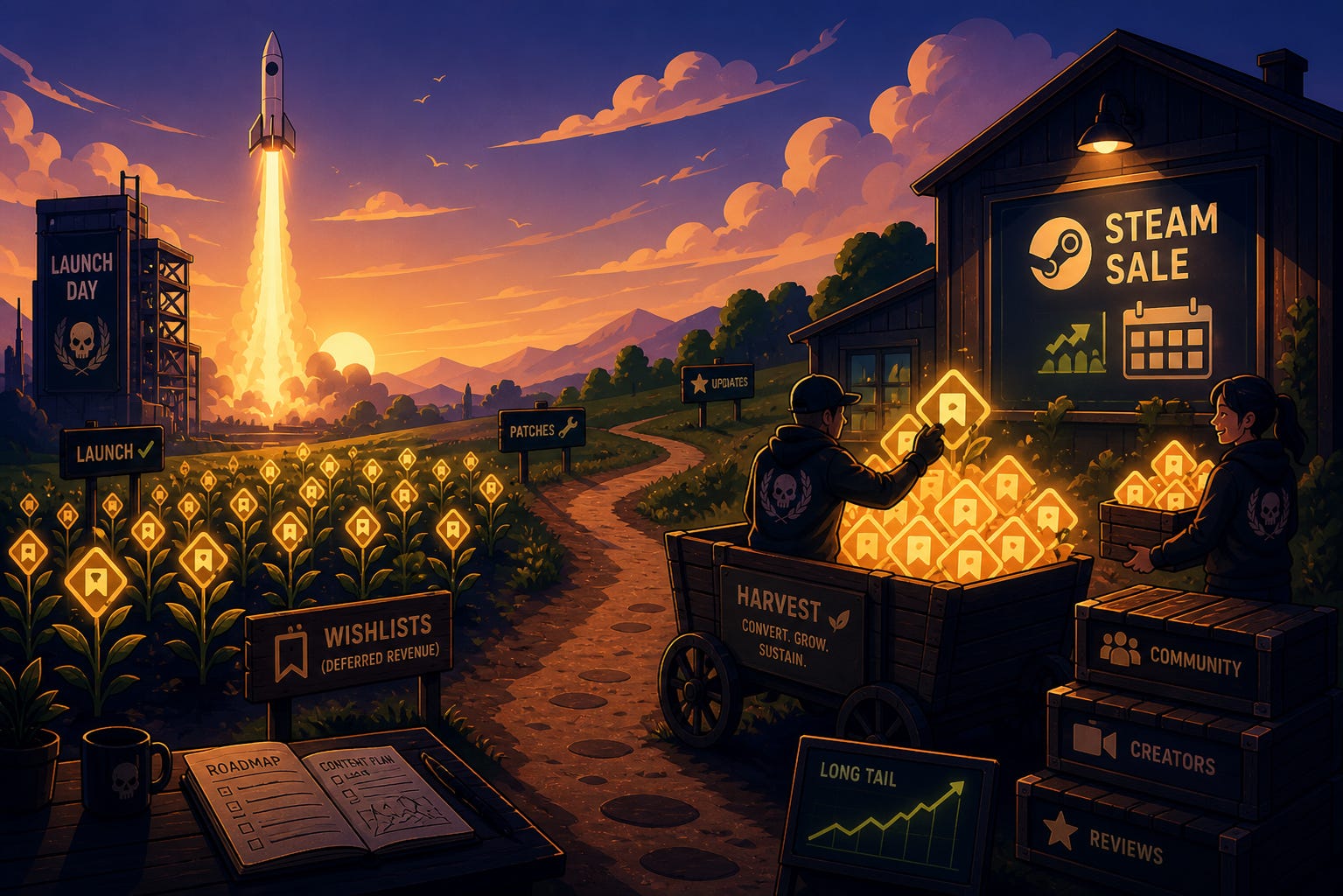
Steam sales are how you monetize your long tail. Plan for a modest first discount (15-20%) and time it to the nearest major Steam sale event, ideally 6-8 weeks post-launch. This captures the players who wishlisted, but didn’t buy at full price. That remaining wishlist backlog is deferred revenue, and sale events are how you convert it.
Deeper discounts (40-60%) work well at 6-12 months post-launch, when you’re shifting from maximizing per-unit revenue to expanding your player base. Regardless of how much you’re discounting, support each sale event with an uptick in marketing activity: email your list, post about it in Discord, update your capsule with a sale-themed variant, and reach out to creators with fresh keys and a new angle (”major update + 40% off for the first time”).
3. Maintain an Active Creator Pipeline
The creators who covered your launch are your warmest relationships. Don’t let them go cold! When your first major content update ships, those creators are the first people who should know. As always, send them a personal message, not a key blast:
“Hey, we shipped the update that adds [feature]. Wanted you to see it first since your coverage was part of why we could build it!”
Mid-tier creators (10k–100k followers) are the sweet spot for post-launch coverage, because they’re large enough to move the needle but small enough to have a genuine relationship with your studio, unmediated by talent management agencies and structured brand deals. Every post-launch update is an opportunity for them to make new content, and for you to reach more players. Everyone wins!
4. Don’t Abandon Your Community, Evolve It!
Community dynamics shift after launch. Before launch, your community drove anticipation for your game… but post-launch, it becomes a retention engine. The Discord goes from asking “when is this thing coming out?” to saying “here’s a bug I found” and “here’s a build guide.” That shift is healthy, normal, and expected. Lean into it!
Studios that sustain post-launch momentum all stay present and active in their community. Note that this doesn’t necessarily mean the founder does this; as your studio grows, you should delegate community management. But regardless of whether you do so, someone should be in the Discord every day, responding to feedback and closing the loop between player input and development output. That loop is how the trust reserve continues compounding long after launch.
5. Measure What Matters Now
Pre-launch, you mainly tracked wishlists. But post-launch, you should track the following three metrics instead:
Review Score: This, more than anything, is what amplifies the algorithm over the long run. Steam’s recommendation engine weights your review score very heavily. A game that launches at Very Positive and maintains it will continue to receive organic traffic for years, while a game that drifts to Mixed will quickly see its organic traffic crater. Each time you respond to a review, patch the game, and interact with your community, you invest in maintaining that score.
Median Playtime: This tells you whether players are finishing (or replaying) your game. A short median playtime, relative to how long your game is, signals that something is causing players to bounce, and that “something” will hurt your algorithmic discovery, either directly (because Steam tracks playtime and uses it, among other metrics, to determine your visibility) or indirectly (through the negative reviews from some of the players who bounced). Prioritize your content updates based on that signal.
Revenue Curve Shape: Your first-week revenue always looks like a spike. But it’s what happens next, however, that determines whether you built a spike or a curve. For games that sustain momentum, Year One revenue typically runs 3-5x the Week One number. Sales almost always drop off after launch (totally normal), but if your revenue flatlines after Week One instead of building a long tail, then either your post-launch marketing isn’t working (fixable), or your game isn’t good enough to sustain word of mouth (uh oh).
Part 2: Can You Overcome a Weak Launch’s Brutal Math?
Now, it’s time to have a much harder conversation. What happens when your game underperforms at launch? In other words, what if your launch is weak? What are your options here?
Let’s start by defining what we mean by “weak.” Basically, a weak launch is the mirror opposite of a strong launch:
Your reviews are Mixed or below
Sales landed at or below your conservative projection
There’s no organic word-of-mouth generating momentum that you didn’t manufacture yourself
I’m going to be really blunt about the data here, because when the stakes are this high, I fervently believe that founders (and their teams, and their teams’ families) deserve honesty more than encouragement or cope.
And the honest truth is… the math is brutal.
The inimitable Chris Zukowski analyzed every Steam game that reached 1,000 reviews in 2024 (so, 445 games in total). Of those, he found exactly one that successfully turned around a genuinely weak launch: Beltmatic, a minimalist automation game that launched with roughly 300 wishlists and earned only 51 reviews in its first three months. A creator named Real Civil Engineer played it, introducing it to a wider creator ecosystem, and after that, the game slowly built momentum over several months.
Again, that’s ONE game out of 445, and that’s only because a creator randomly discovered that game and it happened to be the exact right fit for their audience. That’s just not a replicable strategy for just about any studio. It’s luck (albeit coupled with a good product), and you can’t build a strategy around luck any more than you can plan a nest egg around winning the lottery.
And if you extrapolate Zukowski’s broader finding, it becomes even starker: if your game fails to earn 100 reviews in the first month (whether Early Access or 1.0) there’s a 0.2% chance it will ever reach 1,000 reviews. Notice the decimal place! He’s not saying a 20% chance, or even a 2% chance… his data says you have a zero point two percent chance of turning things around.
That’s not necessarily a death sentence (miracles do happen, as rare as they are), but the odds are very much stacked against you here. So if your launch underperforms, remember that number… and consider it before you decide how to allocate the next six months of your budget (and your life).
Sure, but What CAN Work After a Weak Launch?
Ok, so you’ve read through the entire above section, you’ve talked it over with your team, and came to a decision: numbers and data be damned, you’re going to either beat the odds or die trying. You’re going to sink or swim with your weakly-launched game. So, what can you do to try and turn things around? First of all: good luck. Second, let’s take a clear-eyed and frank look at what the data supports in this regard, and what it doesn’t:
What Doesn’t Work: More of the Same
If your pre-launch marketing didn’t generate enough interest for your game to launch successfully, doing more of the same marketing after launch won’t fix it. Posting more on social media, sending more press emails, being more active on your Discord… none of these will address the underlying problem, which is almost always one of two things: either the game isn’t resonating with the audience you targeted, or you targeted the wrong audience.
What Also Doesn’t Work: Adding Features, as Marketing
A common impulse after a weak launch is to add features (such as a level editor, a new mode, or multiplayer), hoping the new feature will attract a new audience. But unfortunately, Zukowski’s data doesn’t support this; players who weren’t interested in your game at launch are unlikely to suddenly become interested just because you added a random feature. The only exception is if the feature fundamentally changes the game’s value proposition (like No Man’s Sky adding multiplayer), but that’s usually a multi-year, multi-million-dollar commitment that most indie studios can’t make.
What CAN Work, With Caveats:
Targeted and specific creator outreach. The Beltmatic case shows that a single well-matched creator can restart a game’s trajectory… but only if that creator’s audience truly finds the game compelling. If you launched weak and haven’t exhausted your creator outreach list, this is the single highest-leverage post-launch activity you can activate. As always, don’t send a key blast; send targeted and personalized outreach to creators who cover exactly your genre, and give them a real reason to look, whether it’s a significant patch that addresses the game’s launch issues, a new demo, or a fresh new angle.
A major update that addresses players’ core criticism. If your reviews are Mixed because of a specific and addressable problem (common culprits include performance issues, a missing feature that players expected, or a difficulty curve that’s too punishing), fixing that problem and marketing the fix as a relaunch moment can work. BUT… the update has to be substantial enough to convince players who bounced to reconsider; “bug fixes” aren’t substantial enough. “Complete combat rebalance + new progression system + performance overhaul,” on the other hand, might be.
Repricing. If your game launched at $25 and the market is saying “this is a $15 game,” a permanent price reduction combined with a visibility event can reset player expectations. This is undoubtedly painful, but sometimes it’s the only correct action. To make this bitter pill easier to swallow, consider that a game selling 5,000 copies at $15 generates more revenue (and more reviews, and more algorithmic momentum) than a game that sells 1,000 copies at $25.
Accepting the outcome and planning for the next game. Nobody wants to hear this suggestion, but it’s often the most (or only) rational option. If your game launched to Mostly Negative reviews, has fundamental design issues you can’t simply patch out, and generated less than 100 reviews in its first month, then the ROI for post-launch marketing is likely close to zero. Every hour and dollar you spend trying to salvage this launch is an hour and dollar you’re not spending on your next game.
When it’s all said and done, studios don’t survive weak launches because they turn them around (which, as we’ve just seen, is a Herculean and Sysyphean task), but because they learn from them. What did your Scorecard categories look like in retrospect? Where was your marketing system weakest? What would you do differently for your next title? Those lessons, applied to Game Two, will yield far more than spending six months of post-launch marketing on Game One.
The Post-Launch Scorecard
If you take the Game Launch Readiness Scorecard after your game has launched, it adapts! Post-launch users get modified questions:
Next Fest participation becomes post-launch marketing cadence
Wishlist count is reframed as remaining backlog
Recommendations shift from “build before launch” to “sustain or recover after launch”
But all the same structural lessons still apply; studios that built their marketing infrastructure pre-launch (community, leadership, timing, discovery) tend to sustain post-launch momentum. Post-launch marketing doesn’t create those foundations, it only extends them.
Studios that need to recover from a weak launch almost always suffer from structural weaknesses. Whether it’s because they didn’t have enough runway, didn’t hire a marketing lead, didn’t build their community, or had no relationships with creators (or all of the above), the underlying reality remains the same: their launch didn’t fail on launch day; it failed months earlier, when they didn’t build their marketing system.
Which is where this series started… and where it ends.
What’s Next for Ready Check
This is the last foundational piece (for real, this time). Going forward, Ready Check shifts to an irregular cadence: reactive analysis of recent launches, occasional deeper dives into specific categories, and interviews with founders scoring their own games in real time.
If you’ve followed all 12 pieces (er… 13 pieces, including this one), you now have the complete marketing framework you need for a successful launch. The Scorecard operationalizes it, and the articles explain the reasoning behind every weight, every question, and every recommendation.
Now, the ball’s in your court. Take the Scorecard to find out where to start, then go forth and build your marketing system. For real, this time.
Take the Game Launch Readiness Scorecard →
Book a Speedrun Strategy Session →
GG,
~Jay
Spawn Point Marketing offers fractional marketing leadership services for indie and AA game studios. For more information, visit https://spawnpointmarketing.com